The following newspaper extract illustrates the unpopularity of the tithe system in early 19th century Ireland. The Tithes were a tax imposed on the Irish population, regardless of their religion, by the Church of Ireland which was the established church of the state.
The tithes were collected by proctors - in this case, Mr. Hartnett was the proctor for the Rev. John Pennefather of Glebe House, Newport, Tipperary.
This newspaper extract comes from an 1815 edition of 'The Examiner' which was, I believe, an American publication.
‘Cashel, Dec. 23rd - This day, at noon, one Hartnett (the Tithe Proctor of Rev. John Pennefather, Rector of Newport in this county) was murdered by two men at the gate of Monagee, about one mile from this city on the Camas road. As far as we can collect the facts, they are as follows: It has been a general complaint, that notwithstanding the fall of corn, and the distress of the Farmer, the Clergy have been this year rather more greedy in their exactions as ever. Tithes of an enormous amount are at this moment levied; and, where the wretched Cottier is indigent or contamacious, he is summoned to that dread Tribunal ‘The Bishop’s Court’ and there decreed and condemned to pay. The Tithes of Mr. Penefather’s parish (about 30 miles distant) have exceeded the means of some of his Parishioners, and his Proctor, Hartnett (not the most merciful of his tribe) summoned a number of them to the Metropolitan Court in this city, where a Surrogate constantly sit to do ‘justice’. Hartnett, and these poor creatures, had been in attendance here for some days past, several altercations, and much bitterness appeared on both sides. Finally, the Proctor had the good fortune to succeed in all his complaints, and obtained heavy decrees in all his cases. The wretched defendants cried out that they must leave their homes, their wives and children, that they were hardly used, that they must go to America. Hartnett left Cashel, on his return to Newport, accompanied by two other Proctors, who had been upon similar errands. They were met by two men, supposed to be from Newport, who produced blunderbusses, ordered the two other Proctors to return to Cashel, and detained Hartnett as the most obnoxious. They then fired three shots at Hartnett and left him for dead. The surgeon and other persons came out from Cashel and afforded every aid but the Proctor died in three hours. We understand, however, that he had sufficient strength to relate the particulars, and to name the murderers who were well known to him. Persuit was made but, for the present, they have contrived to escape. The weather was dreadful at the time, blowing a dreadful storm, and accompanied by cold heavy rain. The country people were all in their cabins, and no person visible on the road or in the fields, save the parties we have named. Though this outrage hasw occurred in Middlethird Barony, or in a corner of it, yet it is plain that the inhabitants are free from imputation. No precaution on their part could have prevented it. The Tithe System and the ravenous practices employed by the Clergy, are the causes of this and many other calamities. In truth, as Judge Fletcher has briefly expressed it, ‘The Tithe System is not fit for Ireland. The deliberation and effectual care with which this murder was perpetrated are peculiarly calculated to awaken the most serious reflections and to shew, that when the laws become severe in the extreme, they either fail to be effective, or they excite a horrible re-action. These murderers must have been, for some days past, in Cashel, or in its immediate vicinity, watching their victim and waiting their opportunity.’
Showing posts with label Rev.John Pennefather. Show all posts
Showing posts with label Rev.John Pennefather. Show all posts
Edward Pennefather, son of Rev. John Pennefather of Tipperary
Our maternal great-great grandmother was Isabella Pennefather who married Charles Jones Junior in Dublin in 1865.
Isabella Pennefather was a direct descendant of the Pennefathers of Cashel, Tipperary. I'll run through a potted history of the Pennefather family here....
Matthew Pennefather (1618 - 1688) was a Cornet in Cromwell's army who settled in Tipperary - he arrived in Ireland from the ancestral Staffordshire home of the Pennefather family in about 1648. Records show that he was a Quartermaster in the Earl of Mountrath's regiment in 1662, was stationed in Birr in 1664, in Athy in 1668, and had retired from the army by 1685. He received a grant of 1237 acres in the Ballylanigan/Cashel area. Following his marriage to Levina Kingsmill, they lived in the Gort McEllis Castle close to Cashel before inheriting the estate of Ballyowen from Levina's late father. This was renamed as New Park. Both Matthew and Levina Pennefather are buried at the Rock of Cashel.
The son of Matthew and Levina was Kingsmill Pennefather. The son of Kingsmill was Richard Pennefather who was MP for Cashel and High Sherriff of Tipperary. Richard was married to Charity Platten; both are buried at the Rock of Cashel.
It was during this era that the Pennefather family managed to wrestle complete parliamentary and borough control of Cashel. By the 1830s, all 17 aldermen were either Pennefathers or connected by marriage. They were basically the Fianna Fail of their day...
The son of Richard Pennefather was Kingsmill Pennefather who married Mary Lysaght the daughter of Lord Lisle of Mountrath in Cork. The Lysaght family were also associated with Crumlin - the name 'Lysaght' was carried on through the family as a middle name. Kingsmill Pennefather was MP for Cashel in 1753, 1761 and 1771, the year of his death.
The son of Kingsmill Pennefather and Mary Lysaght was the Rev. John Pennefather. (1756 - 1839) The Rev. John Pennefather entered Trinity College in 1779, was 'priested' in Cork in 1882. He subsequently became the Treasurer of Cashel from 1789 - 1796 and was the rector of St. John's Church, Newport, Cashel from 1789 to 1839. He too is buried at the Rock of Cashel, Tipperary.
Rev. John Pennefather married his first unrecorded wife in Cork. (She may have been Catholic and therefore not mentioned in Burke's Peerage.) They had a son, Edward Pennefather, in about 1785. We descend directly from this Edward.
Following the premature death of his first wife, Rev. John Pennefather married Elizabeth Percival in 1789. Among their children - the half-siblings of Edward - were Kingsmill Pennefather, William Westby Pennefather, Sir John Lysaght Pennefather, Laura Pennefather and Joseph Lysaght Pennefather. Their half-brother, Edward, named many of his children after them later.
(Other Relations: Edward's great-uncle was Major William Pennefather whose sons were Richard Pennefather, the Baron of the Exchequer who lived at Merrion Square, Dublin, and also Edward Pennefather, the Lord Chief Justice of Ireland who lived at Fitzwilliam Square.)
The Rolls of the Freemen of Dublin show that Edward Pennefeather (sic) was admitted in 1810; he was noted as a saddler of Grafton Street.
His son, John Pennefather, was admitted to the Freemen of Dublin on 6th September 1845 and the address again given as Grafton Street.
Edward's son, William (Westby) Pennefather, was admitted to the Freemen on 11th March 1858. He was a commercial clerk of 1, Hacketts Buiildings, North Strand, Dublin.
Edward's son, Joseph Lysaght Pennefather, was admitted on 6th May 1858. He was a carpenter, living at home with his parents at 15 Fairview Avenue, Clontarf.
Edward Pennefather was also mentioned in 'The Treble Almanack' of 1815 - under the heading of 'Merchants', Edward Pennefather appears as a saddler at 8 Nassau Street, Dublin, and this tallies with his later entry in Burke's Peerage which gives his address as 8 Nassau Street and Wellington, Templeogue.
Edward Pennefather was, later, a farmer who farmed at Sion outside Maynooth, Co. Kildare - the Tithe Applotment Index (sourced on Ancestry.com) notes him at Laraghbryan townland just outside of Maynooth in 1825. I inspected the Tithe Applotments on microfilm in the National Library - Edward was farming 83 acres of land at Sion, Laraghbryan. Closeby were Thomas Reynolds, 42 acres, and Lawrence Reynolds. I mention the Reynolds because, later in Dublin, a Henry Reynolds witnessed a number of family marriages there along with Edward Pennefather's son, John Pennefather.
On 5th June 1821, Edward Pennefather married Eliza or Elizabeth White, the daughter of George White of St. Peters parish, south of Stephens Green in Dublin. The witnesses to the marriage were Robert Morrisson - possibly a cook/vintner of Dawson Street - and W.C. Humphries who was, perhaps, the Staff Surgeon of the Royal Military Hospital, Phoenix Park.
The Dublin voters lists for 1832 note Edward Pennefather, farmer, at Tallaght, Newcastle, Co. Dublin.
The Dublin Register of Voters for 1837 shows Edward Pennefather, a farmer, living at Wellington (Crumlin), Co. Dublin.
His wife, Elizabeth White, was born about 1795 to George and Ann White, and died at Fairview Avenue, Clontarf, on 1st Jan. 1864.
http://alison-stewart.blogspot.ie/2014/08/george-and-ann-white-parents-of-eliza.html
I found a reference to the birth of two of their children - by this time the couple gave their address as Crumlin but Burke's Peerage give the address as Wellington, Templeogue. Modern maps show Wellington Road, Templeogue as being next to Crumlin Commons.
The children of Edward and Elizabeth Pennefather were as follows:
John Lysaght Pennefather, who was the father of our great-great grandmother Isabella Pennefather Jones.
Edward Pennefather, later of Cahore, Wexford - he married a Sarah Turner.
William Westby Pennefather, married to Emma Hay.
Joseph Lysaght Pennefather, born in Crumlin/Templogue on 10th Dec 1834. Married Helen Dunne.
George Pennefather, born in Crumlin/Templeogue on 13th Oct 1836, died of cholera in 1849 aged 13.
Maria Pennefather married William Bonis of Longford.
Edward and Eliza Pennefather lived for a time at 4 Nottingham Street near Parnell Square in Dublin city before moving out to Clontarf, north of the city. In 1847 when Edward's son, John, married Emily Courtenay in St. Marys, Dublin, it was stated on the marriage cert that Edward was a farmer although the address was not noted.
By June 3rd 1856 when Edward's son, William Westby Pennefather, married Emma Hay in St.Thomas's on Cathal Brugha Street, the family had moved out to Clontarf. Emma Hay was living at 17 Newcomen Place off the North Strand Road. The marriage certificate stated that William's father, Edward, was a gentleman; Emma's father was Alexander Hay an engineer of Galway who supervised work at Roundstone and Cleggan Piers in the 1820s. Witnesses to the wedding were his children Eliza Hay and David A. Hay. (The son of this David Hay, Percy Hay, later witnessed the wedding of Isabella Jones to Robert James Mottershed in 1897.)
In 1860, William Westby Pennefather witnessed the wedding of Eliza Hay (who had been the witness to his own wedding) to Robert B. Ince.
The 1835 Electoral List shows Alenxander Hay, architect and engineer, living at 21 Bayview Avenue; in 1824 he had been noted at Dominick Street, Galway.
(Also: When William Pennefather married Emma Hay in 1856, she had been living at 17 Newcomen Road off the North Strand. Earlier the same year another woman, Sarah Maria Sadleir, who had been living at the same address, married Henry Torrens Owens of 23 Wellington Street, which is the street the Courtenays lived on. William's brother, John Pennefather, married Emily Courtenay of Wellington Street. The witnesses to the Sadleir/Owens marriage were William Pennefather and James E. Sadleir. The Sadleirs were a Cromwellian family who settled in Tipperary as did the Pennefathers. I wonder were Sarah Maria and James E. Sadleir related to the infamous John and James Sadleir who broke the bank of Tipperary in the 1850s? One of them - John - committed suicide on Hampstead Heath; the other fled to the continent in disgrace and was murdered during a botched robbery in 1881.)
On 27th July 1859 Edward's daughter, Maria Pennefather, married William Bonis CE (ie, civil engineer) - William's father was Daniel Bonis a farmer. They gave their address as Clonturk which is the Clontar/Drumcondra area just north of the North Strand road. Maria Pennefather Bonis was later a witness at the wedding of Isabella Pennefather, her niece, and Charles Jones Junior in 1865. William Bonis died in 1874.
Edward's wife, Elizabeth Pennefather, née White, died at 15 Fairview Avenue, Clontarf, on 1st January 1864. She had been ill for seven days with bronchitis which killed her. Her daughter, Maria Bonis, was present at death.
From the Dublin Electoral Roll of 1865 I found Edward Pennefather's address: 15 Fairview Avenue, Clonturk.
Also living there with him was his son, Joseph Lysaght Pennefather, and his son-in-law William Bonis.
On 2nd August 1867, Edward's son, Joseph Lysaght Pennefather, married Helen Dunn/Dunne in St. Thomas's Church, Cathal Brugha Street. Her address was 4 Coburg Place close to Seville Place where Edward's son, John, was living at that time. Joseph Lysaght Pennefather was actually living and working as a builder in Belfast - at Gloucester Street near Donegall Square - at the time of his marriage to Eleanor whose father was a bookkeeper named Benjamin Dunne. The witnesses: Benjamin Dunne and Henry James Dunne.
I found references to a builder, Joseph Pennefather, and the 1901 Census confirms this profession - in 1901 Joseph was back living in Dublin at Bloomfield Avenue, Wood Quay, and he gives his profession as a clerk of works.
Edward's other son, John Pennefather, married Emily Courtenay in the Black Church of Dublin in 1848 - they were our maternal great-great-great grandparents and I'll do a separate post about them.
http://alison-stewart.blogspot.com/2011/07/john-pennefather-and-emily-courtenay.html
The following post gives more detail:
http://alison-stewart.blogspot.com/2011/09/children-of-edward-pennefather-of.html
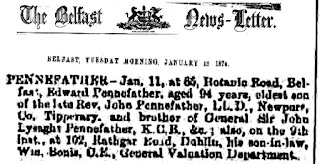
Edward Pennefather died in Belfast on January 11th 1874 at the Belfast residence of his son, Joseph Lysaght Pennefather, 65 Botanic View. Edward, a gentleman farmer, had died of senile decay which he'd been suffering from for the previous 12 months.
 |
| New Park, Tipperary |
Isabella Pennefather was a direct descendant of the Pennefathers of Cashel, Tipperary. I'll run through a potted history of the Pennefather family here....
Matthew Pennefather (1618 - 1688) was a Cornet in Cromwell's army who settled in Tipperary - he arrived in Ireland from the ancestral Staffordshire home of the Pennefather family in about 1648. Records show that he was a Quartermaster in the Earl of Mountrath's regiment in 1662, was stationed in Birr in 1664, in Athy in 1668, and had retired from the army by 1685. He received a grant of 1237 acres in the Ballylanigan/Cashel area. Following his marriage to Levina Kingsmill, they lived in the Gort McEllis Castle close to Cashel before inheriting the estate of Ballyowen from Levina's late father. This was renamed as New Park. Both Matthew and Levina Pennefather are buried at the Rock of Cashel.
The son of Matthew and Levina was Kingsmill Pennefather. The son of Kingsmill was Richard Pennefather who was MP for Cashel and High Sherriff of Tipperary. Richard was married to Charity Platten; both are buried at the Rock of Cashel.
It was during this era that the Pennefather family managed to wrestle complete parliamentary and borough control of Cashel. By the 1830s, all 17 aldermen were either Pennefathers or connected by marriage. They were basically the Fianna Fail of their day...
The son of Richard Pennefather was Kingsmill Pennefather who married Mary Lysaght the daughter of Lord Lisle of Mountrath in Cork. The Lysaght family were also associated with Crumlin - the name 'Lysaght' was carried on through the family as a middle name. Kingsmill Pennefather was MP for Cashel in 1753, 1761 and 1771, the year of his death.
The son of Kingsmill Pennefather and Mary Lysaght was the Rev. John Pennefather. (1756 - 1839) The Rev. John Pennefather entered Trinity College in 1779, was 'priested' in Cork in 1882. He subsequently became the Treasurer of Cashel from 1789 - 1796 and was the rector of St. John's Church, Newport, Cashel from 1789 to 1839. He too is buried at the Rock of Cashel, Tipperary.
Rev. John Pennefather married his first unrecorded wife in Cork. (She may have been Catholic and therefore not mentioned in Burke's Peerage.) They had a son, Edward Pennefather, in about 1785. We descend directly from this Edward.

Following the premature death of his first wife, Rev. John Pennefather married Elizabeth Percival in 1789. Among their children - the half-siblings of Edward - were Kingsmill Pennefather, William Westby Pennefather, Sir John Lysaght Pennefather, Laura Pennefather and Joseph Lysaght Pennefather. Their half-brother, Edward, named many of his children after them later.
(Other Relations: Edward's great-uncle was Major William Pennefather whose sons were Richard Pennefather, the Baron of the Exchequer who lived at Merrion Square, Dublin, and also Edward Pennefather, the Lord Chief Justice of Ireland who lived at Fitzwilliam Square.)
The Rolls of the Freemen of Dublin show that Edward Pennefeather (sic) was admitted in 1810; he was noted as a saddler of Grafton Street.
His son, John Pennefather, was admitted to the Freemen of Dublin on 6th September 1845 and the address again given as Grafton Street.
Edward's son, William (Westby) Pennefather, was admitted to the Freemen on 11th March 1858. He was a commercial clerk of 1, Hacketts Buiildings, North Strand, Dublin.
Edward's son, Joseph Lysaght Pennefather, was admitted on 6th May 1858. He was a carpenter, living at home with his parents at 15 Fairview Avenue, Clontarf.
Edward Pennefather was also mentioned in 'The Treble Almanack' of 1815 - under the heading of 'Merchants', Edward Pennefather appears as a saddler at 8 Nassau Street, Dublin, and this tallies with his later entry in Burke's Peerage which gives his address as 8 Nassau Street and Wellington, Templeogue.
Edward Pennefather was, later, a farmer who farmed at Sion outside Maynooth, Co. Kildare - the Tithe Applotment Index (sourced on Ancestry.com) notes him at Laraghbryan townland just outside of Maynooth in 1825. I inspected the Tithe Applotments on microfilm in the National Library - Edward was farming 83 acres of land at Sion, Laraghbryan. Closeby were Thomas Reynolds, 42 acres, and Lawrence Reynolds. I mention the Reynolds because, later in Dublin, a Henry Reynolds witnessed a number of family marriages there along with Edward Pennefather's son, John Pennefather.
On 5th June 1821, Edward Pennefather married Eliza or Elizabeth White, the daughter of George White of St. Peters parish, south of Stephens Green in Dublin. The witnesses to the marriage were Robert Morrisson - possibly a cook/vintner of Dawson Street - and W.C. Humphries who was, perhaps, the Staff Surgeon of the Royal Military Hospital, Phoenix Park.
The Dublin voters lists for 1832 note Edward Pennefather, farmer, at Tallaght, Newcastle, Co. Dublin.
The Dublin Register of Voters for 1837 shows Edward Pennefather, a farmer, living at Wellington (Crumlin), Co. Dublin.
His wife, Elizabeth White, was born about 1795 to George and Ann White, and died at Fairview Avenue, Clontarf, on 1st Jan. 1864.
http://alison-stewart.blogspot.ie/2014/08/george-and-ann-white-parents-of-eliza.html
I found a reference to the birth of two of their children - by this time the couple gave their address as Crumlin but Burke's Peerage give the address as Wellington, Templeogue. Modern maps show Wellington Road, Templeogue as being next to Crumlin Commons.
The children of Edward and Elizabeth Pennefather were as follows:
John Lysaght Pennefather, who was the father of our great-great grandmother Isabella Pennefather Jones.
Edward Pennefather, later of Cahore, Wexford - he married a Sarah Turner.
William Westby Pennefather, married to Emma Hay.
Joseph Lysaght Pennefather, born in Crumlin/Templogue on 10th Dec 1834. Married Helen Dunne.
George Pennefather, born in Crumlin/Templeogue on 13th Oct 1836, died of cholera in 1849 aged 13.
Maria Pennefather married William Bonis of Longford.
Edward and Eliza Pennefather lived for a time at 4 Nottingham Street near Parnell Square in Dublin city before moving out to Clontarf, north of the city. In 1847 when Edward's son, John, married Emily Courtenay in St. Marys, Dublin, it was stated on the marriage cert that Edward was a farmer although the address was not noted.
By June 3rd 1856 when Edward's son, William Westby Pennefather, married Emma Hay in St.Thomas's on Cathal Brugha Street, the family had moved out to Clontarf. Emma Hay was living at 17 Newcomen Place off the North Strand Road. The marriage certificate stated that William's father, Edward, was a gentleman; Emma's father was Alexander Hay an engineer of Galway who supervised work at Roundstone and Cleggan Piers in the 1820s. Witnesses to the wedding were his children Eliza Hay and David A. Hay. (The son of this David Hay, Percy Hay, later witnessed the wedding of Isabella Jones to Robert James Mottershed in 1897.)
In 1860, William Westby Pennefather witnessed the wedding of Eliza Hay (who had been the witness to his own wedding) to Robert B. Ince.
The 1835 Electoral List shows Alenxander Hay, architect and engineer, living at 21 Bayview Avenue; in 1824 he had been noted at Dominick Street, Galway.
(Also: When William Pennefather married Emma Hay in 1856, she had been living at 17 Newcomen Road off the North Strand. Earlier the same year another woman, Sarah Maria Sadleir, who had been living at the same address, married Henry Torrens Owens of 23 Wellington Street, which is the street the Courtenays lived on. William's brother, John Pennefather, married Emily Courtenay of Wellington Street. The witnesses to the Sadleir/Owens marriage were William Pennefather and James E. Sadleir. The Sadleirs were a Cromwellian family who settled in Tipperary as did the Pennefathers. I wonder were Sarah Maria and James E. Sadleir related to the infamous John and James Sadleir who broke the bank of Tipperary in the 1850s? One of them - John - committed suicide on Hampstead Heath; the other fled to the continent in disgrace and was murdered during a botched robbery in 1881.)
On 27th July 1859 Edward's daughter, Maria Pennefather, married William Bonis CE (ie, civil engineer) - William's father was Daniel Bonis a farmer. They gave their address as Clonturk which is the Clontar/Drumcondra area just north of the North Strand road. Maria Pennefather Bonis was later a witness at the wedding of Isabella Pennefather, her niece, and Charles Jones Junior in 1865. William Bonis died in 1874.
Edward's wife, Elizabeth Pennefather, née White, died at 15 Fairview Avenue, Clontarf, on 1st January 1864. She had been ill for seven days with bronchitis which killed her. Her daughter, Maria Bonis, was present at death.
From the Dublin Electoral Roll of 1865 I found Edward Pennefather's address: 15 Fairview Avenue, Clonturk.
Also living there with him was his son, Joseph Lysaght Pennefather, and his son-in-law William Bonis.
On 2nd August 1867, Edward's son, Joseph Lysaght Pennefather, married Helen Dunn/Dunne in St. Thomas's Church, Cathal Brugha Street. Her address was 4 Coburg Place close to Seville Place where Edward's son, John, was living at that time. Joseph Lysaght Pennefather was actually living and working as a builder in Belfast - at Gloucester Street near Donegall Square - at the time of his marriage to Eleanor whose father was a bookkeeper named Benjamin Dunne. The witnesses: Benjamin Dunne and Henry James Dunne.
I found references to a builder, Joseph Pennefather, and the 1901 Census confirms this profession - in 1901 Joseph was back living in Dublin at Bloomfield Avenue, Wood Quay, and he gives his profession as a clerk of works.
http://alison-stewart.blogspot.com/2011/07/john-pennefather-and-emily-courtenay.html
The following post gives more detail:
http://alison-stewart.blogspot.com/2011/09/children-of-edward-pennefather-of.html
Edward Pennefather died in Belfast on January 11th 1874 at the Belfast residence of his son, Joseph Lysaght Pennefather, 65 Botanic View. Edward, a gentleman farmer, had died of senile decay which he'd been suffering from for the previous 12 months.
Subscribe to:
Posts (Atom)