Willis Creighton Williams and Kate O'Neill


Willis Creighton Williams was born to Richard Williams and Geraldine O'Moore Creighton in Dublin on 29th October 1854.
http://alison-stewart.blogspot.ie/2011/08/richard-williams-and-geraldine-omoore.html

Richard Williams and Geraldine O'Moore Creighton were my mother's great-grandparents.

It is said that Thomas Barnardo, the Dublin-born founder of the Barnardo Childrens' Homes and a friend of the Williams family, had given the young Willis a pet white rabbit when Barnardo left Dublin to train in London.

According to his daughter, Eliza Willis Williams, Willis spent some time at a boarding school in England when he was a child.  This was confirmed by the 1871 UK census, which showed the young Willis as a boarder at the school of Benjamin and Henrietta Ellis  at 56 and 57 St. Mary's Road, Camberwell, South London. Willis was aged either 14 or 15; whoever wrote out the census return wasn't sure about this.
He was a sporting individual - on 7th August 1875, aged about 21, he won first prize for a three-mile walk in the O'Connell Centenary Athletic Sports.  The following year he won second prize in the four-mile open walking race of the D.U.A.S.  (Dublin United Athletic Society.)
In 1876 he took part in the Three Mile Walk at the Landsdowne Road Athletics Meeting. The following year he took part in the walking matches at the Rotundo Skating Rink.

In 1879, Willis Creighton Williams of Dundrum applied for a dog licence.


He married Kate O'Neill on 3rd March 1881 at Birkenhead, Cheshire (Liverpool) - at the time they were living at 12 Queen Street;  the following year they had moved to 53 Clarence Grove, Everton.  The marriage was witnessed by A.J.Gregory and L.B. Gregory, who seem to be Arthur James Gregory and Lilian Baxter Gregory, aged 17 and 19 on the 1881 UK Census, who were the children of Peter Gregory and Emma Ann Baxter - Peter Gregory was an accountant/clerk to the Board of Guardians;  in 1881, this family were living in Birkenhead at 19 Hamilton Square, Birkenhead.  Hamilton Square runs directly onto Argyle Street which swings around into Queen Street where Willis C. Williams and Kate O'Neill were living at the time of their 1881 marriage, so perhaps the two families were most likely friends with each other.
Both addresses are close to the Liverpool Docks and family tradition has it that Willis Creighton Williams worked for the City of Dublin Steam Packet Company like his father, Richard Williams, before him, although  later family members may be confusing Willis with his father, Richard.  Charles Wye Williams himself had lived in the same city - he had chosen Liverpool as a location for the company because of its harbour which was, in the 1820s, far superior to Dublin Port. 

Following their 1881 marriage, the UK census captured the newly-weds living at 4 Kirkdale Road, Merseyside, Liverpool, where Willis was recorded as a house agent and tea dealer.  The census transcribed his name as Willie B. Williams;  Kate called herself Katie.  There were no children present in the household, which is peculiar, given that their eldest son, Willis Creighton Williams,  had been born in Liverpool in about 1875.

Kelly's Directory for Liverpool listed Willis Willams of 4 Kirkdale Road as a grocer in 1881.  The family were still in Liverpool when their second son, David Creighton Williams was born on 31st May 1882.

By 1886, Willis Creighton Williams and Kate O'Neill had returned to Dublin - they lived firstly at 50 Park Avenue, Sandymount;  13 Park Avenue, Sandymount;  38 Grosvenor Square, Rathmines.

The Family of Kate O'Neill:
Kate O'Neill had been born to a farmer,  Henry Neill or O'Neill in Carrawaystick, Rathdrum, Co. Wicklow, on 29th August 1858 and was baptised in Rathdrum Catholic Church by her parents, Henry and Maria or Mary Neill.   The family name was 'Neill' at that time, although by the time of the 1901 census they seem to have preferred 'O'Neill'.  Other spellings of the name include 'Neil' or 'Neille'.

Although the 19th century church and civil records link my O'Neill family to Carrawaystick in Rathdrum, they may only have been farming there for a number of decades and may have originated in a completely different area.  By 1901 the only member of the O'Neill family living there was Mary Kavanagh, the daughter of Nicholas Neill and Rose Byrne.   Nicholas Neill was closely related to my immediate ancestor, Henry Neill, but the exact relationship is as yet unknown.   Nicholas married in 1833 whilst Henry married in 1855 - were they father and son or brothers with a wide age gap??

The earliest mention of the Neill family in conjunction with Carrawaystick occurs in the Rathdrum parish register.  On 24th March 1826, Joseph Neill and Ann Byrne were the sponsors at the baptism of Hester Byrne, the daughter of Michael and Margaret Byrne of Carrawaystick.
Also, on 29th November 1819, Thomas Neill and Caty Farrell were the sponsors in Carrawaystick of Margery Headon, when she was baptised by her parents, Thomas Headon or Heaton and Winny Byrne.


The Tithes Applotments of 1825 noted Patt and Thos. Neill, John Neil with William Fleming, Thos Snell (their landlord), and Michael and Matthew Fleming all farming in Carrawaystick.

Griffiths Valuation of  1854 showed our immediate ancestory Henry Neil at Carrawaystick, Knockrath, Ballinacor South, Co. Wicklow, farming 75 acres along with Nicholas Neil and William Shannon.  In the same townland was an Edward Neil.

An Edward Neil was baptised in Rathdrum on 2nd April 1797 by his parents John Neil and Mary Cavanagh.  The witnesses were James and Margaret Headon.   The Rathdrum register recorded the later baptism, on 29th November 1819, of Margery Headon by Thomas Headon and Winny Byrne of Carrawaystick, and this was sponsored by Thomas Neill and Caty Farrell.

John Neill, the father of Edward Neil of Carrawaystick, might well be the John Neil who sponsored the baptism in March 1825 of Hester Byrne, the daughter of Michael and Margaret Byrne of Carrawaystick.

An Edward Neille married a Catherine McGrath or Maguire (?) in Rathdrum on 18th February1833 - this was witnessed by a Laurence Kavanagh and a Mary or Margaret Neille.  The priest's handwriting in the register was 'original' at this point.  Was this the Edward Neille who had been baptised by John Neille and Mary Cavanagh in Rathdrum in 1797.

Another Edward Neil of Carrawaystick married Anne Grogan in Rathdrum on 26th September 1852; this was witnessed by Margaret Grogan and John Doyle.  Could this be a second marriage for Edward Neille who had been patised in 1797??
By 1858 he had moved north to Brockagh where, on the 5th May 1858, he and Anne Grogan baptised their son James Neille in Glendalough Church.
Edward Neill must have died at some stage between 1858 and 1865 - on 26th November 1865, the widowed Anne Neil of Laragh, daughter of Patrick Grogan, remarried.  Her second husband was the shoemaker Peter Cullen of Laragh, the son of farmer Christopher Cullen. The witnesses to this second wedding were Michael Keely and Sarah Toole.
Peter Cullen and Anne Grogan had a daughter Mary Cullen on 18th November 1865.

A recent DNA test with Ancestry confirms me to be a close relation of Nicholas Neil of Carrawaystick, who was farming there alongside my own ancestor Henry Neil.  I'm as yet unsure as to the exact relationship between Nicholas and my own ancestor Henry. 


The House of Nicholas Neil at Carrawaystick, courtesy of his descendant (and my DNA match) Margaret Flood


The Neill's home was situated to the left of the waterfall's base - this charming cottage would have belonged to one of their immediate neighbours in Carrawaystick townland.

The Neill's homestead was situated in the green field to the left of the red-roofed cottage - all that remains now of their house is a pile of rubble.

Nicholas Neill of Carrawaystick married Rose Byrne in Rathdrum on 28th January 1833; witnesses were James and Mary Fahy.   

Son Patrick Neil was baptised on 5th June 1836 in Rathdrum - sponsors were  Henry Neil, and Mary Farrell.   Was this Henry Neil my immediate ancestor or another member of this family??

Mary Neil was baptised by Nicholas and Rose Neil in February 1838 but she must have died young.

A second Patrick was baptised by Nicholas and Rose Neill on 4th July 1840 in Carrawaystick  - sponsors were John Hyland and Mary Doyle.  The first Patrick must have died.

Mary Neil was baptised on 3rd December 1843 - her parents were of Glenamalure and the sponsors to 
the baptism were James and Bridget Byrne.  
On 11th July 1868, the daughter of Nicholas, Mary Neill of Clornee, married Christopher Kavanagh, the son of Mathew Kavanagh and Margaret Lambert of Drumgoff.  The witnesses were Jacob Kavanagh of Carrig and the bride's sister Margaret Neil of Knockrath.   In both 1901 and 1911, Mary and Christopher Kavanagh were living in Carrawaystick.

On 1st October 1846  Nicholas and Rose baptised their daughter, Sarah Neill of Glenmalure; sponsors were Bernard Farrell and Elizabeth Wall.  Sarah Neill married Mathew Flood in Rathdrum on 9th October 1875.  Mathew Flood was living in Ballinabarney and was the son of Patrick Flood, while Sarah was noted as living in Ballintonbay Lower at the time of the wedding.  The witnesses were Sarah's younger sister, Margaret Neill, and James Kinshella.
Sarah Flood would die in Ballinabarney, Greenane, Co. Wicklow, on 12 May 1923 - a Matthew Graham was present when she died.    We have a strong DNA match to her descendant, Margaret Flood, who kindly shared her black and white photo of her Nicholas Neill's home in Carrawaystick.

Margaret Neill of Carrawaystick was baptised by Nicholas and Rose on 22nd April 1851; sponsors were Thomas Neill and Elizabeth Donnelly.  
On 19th January 1880 Margaret Neil of Ballintonbay married George Farrell of Killystown, the son of Bryan and Bridget Farrell.   The witnesses were Mathew Farrell of Corsillagh and Eliza Byrne of Ballinabarney.

My mother's paternal grandparents were Willis Williams and Kate O'Neill.  Kate's parents, Henry and Maria Neill married in Rathdrum Church on 1st October 1855;  the witnesses were Thomas and Elizabeth Neil.   The parish register does not name the parents of the bride and groom.

The children of Henry and Maria Neil of Carrawaystick were christened in Rathdrum.   
  • Patrick Neil was born on 17th March 1856 and baptised on the 19th;  the sponsor was James Neill.  
  • Our great grandmother, Catherine Neil was born on 29th August 1858 and baptised on 1st September;  her sponsors at the baptism in Rathdrum were John and Catherine Fleming.
  • Maria Neil was born to Henry and Maria on 15th May 1860 and was baptised on the 19th;  she was sponsored by Pat Nolan and Elizabeth Neil.
  • Thomas Neil was born on 19th September 1862 and baptised on 23rd september 1862;  the sponsors were John Byrne and Martha Fleming.

Kate's older brother, Patrick Neil of Carrawaystick, Rathdrum, married, in Greenane Church on 21st January 1883, Catherine Farrell of Corsilla, Rathdrum, the daughter of Bernard Farrell;  the marriage registration certifcate noted that both Henry Neil and Bernard Farrell were still alive in 1883.  The witnesses were Patrick Byrne and Mary Farrell.        
Patrick Neil and Catherine Farrell had a son, Henry, in Carrawaystick on 29th July 1885.   On 24th May 1889, they also had Bernard Neile in Glenmalure; grandmother, Bridget Farrell, was present at Bernard's birth.

Kate's brother, Patrick Neil of Carrawaystick, was charged on 29th November 1883, with poaching a rabbit on the Clohernagh property of Michael Farrell.  There was little love lost between our Patrick Neil and Michael Farrell - also in November 1883, Patrick Neil accused Michael Farrell of stealing traps from his land, and also of withholding Patrick's wages of £3:14:0 as labourer/servant.

Following the birth of Patrick's son, Bernard, in 1889, I can no further record of this family either.  None of them appear on the 1926 Irish Census.  In common with so many of this elusive family, they seem to have disappeared in a puff of smoke.

Kate's father, Henry Neil/Neill/O'Neill of Carrawaystick, was charged in the Petty Courts on 4th May 1882 with refusal to pay the Guardians of the Poor of the Rathdown Union for seed.  He made no appearance and I can find no further record of him online.  

The Farrell Family of Corrasillagh:
The Farrell family of Corsilla/Corrasillagh in Rathdrum recur in this Neill genealogy.  Henry Neil's son, Patrick Neil of Carrawaystick, as already noted, married Catherine Farrell in 1883.   She was the daughter of Bernard Farrell - a Bernard Farrell had earlier witnessed the baptism of Sarah Neil, the daughter of Nicholas and Rose Neil of Carrawaystick in 1846.  

A Bernard Farrell of Corrasillagh, who was married to Bridget Byrne, baptised three children in Rathdrum - Maria Farrell was born on 20th August 1864, Bridget on 2nd June 1866 and Bernard Farrell on 3rd June 1874.

Another Bernard Farrell of Corrasillagh, the son of James Farrell and Mary Byrne, married Ellen Byrne, the daughter of Michael and Bridget Byrne of Clohernagh, on 22nd June 1876.   Was this second Bernard Farrell a cousin of the first one?

On 14th December 1851, James and Mary Farrell of Corasilla baptised their son, James Farrell, in Rathdrum.

On 10th January 1873, George Farrell, the son of George Farrell and Maria Case (?), married Susanna Mernagh, the daughter of Michael Mernagh and Susannah Kennedy.

DNA LINKS:

My mother and I, who descend from Kate O'Neill of Carrawaystick,  have numerous DNA links to the descendants of Patrick Neille and Hannah Malone.  Was this Patrick the man who was recorded as farming in Carrawaystick in 1825?   The multiple DNA matches confirm him as a relation of our immediate ancestor Henry O'Neill of Carrawaystick.

This Patrick Neille married Hanna Malone in Rathdrum Church on 21st June 1831;  this was witnessed by John and Martha Cullen.   Patrick and Hanna subsequently settled in Churches/Brockagh townland in Derrylossary parish just north of Laragh and Griffith's land survey of 1854 record Patrick farming 35 acres here.

The witnesses to the wedding of Patrick Neille and Hannah Malone were John and Martha Cullen.  Martha Cullen was Hannah's sister - on 2nd February 1831 in Rathdrum parish, Martha Malone had married John Cullen and this was witnessed by Hannah Malone and an illegible member of the Cullen family.  The Rathdrum parish register recorded the baptism of some of the children of John Cullen and Martha Malone -  Thomas Cullen was baptised in December 1831, Mary Cullen on 30th April 1834 and an unnamed child in April 1836.   A John Cullen and Martha Malone, who may or may not be the same couple, then baptised children in Rathfarnham, Co. Dublin - Mathew Cullen was baptised there on 4th November 1838, a child was baptised there on 12th March 1841,  Lucy Cullen on 14th January 1844. Catherine Cullen was baptised in Rathfarnham on 17th April 1846 and John Cullen on 4th April 1849. 
A Martha Cullen died, aged 90, in Ballincarrig, Rathdrum, on 6th June 1899 - she was noted as the widow of a labourer. 

But to return to Patrick Neille and Hannah Malone.   The baptisms of some of the children of Patrick Neille and Hannah Malone are recorded in the Glendalough baptismal register.

Mary Neil was baptised on 29th March 1835 (sponsors were John Neill and Honora Byrne).
Thomas Neil was baptised on 3rd November 1839 (sponsored by James Doyle and Ellen Cullen).
John Neil of Churches was baptised on 3rd February 1842 (sponsored by George Neil and Elizabeth Reid).
Anne Neil of 7 Churches was baptised on 18th May 1843 (sponsored by John Byrne and Anne Doyle).
Laurence Neil of Churches was baptised on 13th August 1844 (sponsored by John and Catherine Byrne).
Peter Neil of Churches was baptised on 13th January in the famine year of 1847.
Martin Neil of Churches was baptised on 2nd July 1848.
Hannah Neil was baptised on 20th January 1850 (sponsored by Joseph and Anne Malone).
Francis Neil of Brockagh was baptised on 2nd April 1853 (sponsored by James and Mary Farrell).

On 6th November 1865 in Glendalough parish, James Neill of Brockagh, son of the farmer Patrick Neill, married Jane Mahon of Knockfin, the daughter of Richard Mahan.   The Roundwood parish register name Jane's parents as Richard Mahan and Elizabeth Doyle.     

James Neill and Jane Mahon of Brockagh had a daugher,  Elizabeth Neill, in Rathnew on 20th August 1870.   They also had a daughter, Jane Neil, in Rathnew on 21st January 1876 - James was named as a publican when they registered the birth of their daughter.
DNA links us once again to Patrick O'Neill who had been born in 1868 to James Neill and Jane Mahon of Brockagh and who was the grandson of Patrick Neill and Hannah Malone of Brockagh. Patrick O'Neill emigrated in 1884 to New York and then to Pennsylvannia where the 1910 census recorded him working as a miner.   He had married Mary Martin on 8th April 1896 in Manhattan before having children in Pennsylvania, amongst them Richard O'Neill who was born there in 1904 and whose descendant is a DNA match to myself and to my mother.
Elizabeth Neill, the daughter of James Neill and Jane Mahon, and granddaughter of Patrick Neill and Hannah Malone, seems to be the Elizabeth O'Neill who emigrated to Newark, New Jersey, in about 1890 where she married Lawrence Farrell on 9th October 1896.    Again, we have a strong DNA match with her descendants.   On the various US censuses, Elizabeth gives her year of birth differently each time which highlights the fact that not many people knew or cared about their date of birth at this time. Lawrence Farrell died on 19th March 1923 and his wife, Elizabeth O'Neill, died on 4th January 1932 - they are buried in Holy Cross Cemetery in New Jersey.   Their children were James Anthony Farrell, Mary Farrell, Lawrence Farrell, John Sylvester Farrell and Hannah Farrell.

Thomas Neil of Brockagh, the son of farmer Patrick Neil and Hannah Malone, was a shoemaker who married Anne Nolan, the daughter of James Nolan, on 24th July 1866 - this was sponsored by the groom's brother, Peter Neil, and by Eliza Nolan.   My mother and I match strongly with US-based descendants of this couple.
Their children was also baptised in Glendalough church and the records survive and are free to view online via the National Library of Ireland's website.

The children of Thomas Neil and Anne Nolan were:

John Neill was born in Brockagh on 20th March 1867 - sponsors were Michael and Bridget Nolan.  We match very strongly with descendants of John O'Neill who emigrated to Newark, New Jersey, in 1886 where he married Mary Hogan who had been born November 1872 in Ireland, most likely in Glendalough to Daniel Hogan and Mary Cody.  John O'Neill gave his date of birth on one of the US census returns as May 1867 but this might have been in error.   In 1910 this family were living in Newark along with John O'Neill's brother, Patrick O'Neill, who gave his birthdate as August 1868.   Again, this was slightly incorrect - Patrick had been born in June 1868.

Patrick Neill was born on 8th June 1868 - sponsors were Francis Neil (the baby's uncle who had been born in 1853?) and Elizabeth Nolan.   Patrick emigrated to New Jersey.  He married Emily Hogan. She had been baptised in Glendalough, Co. Wicklow, on 8th December 1872 by Daniel Hogan and Mary Cody of Brockagh.  Her sister might be the Mary Hogan who married her brother-in-law John O'Neill. Emily and Patrick O'Neill had a daughter, Annie O'Neill, in New Jersey in April 1897 but, by 1910 his wife had died and he was living with his daughter at the home of his older brother John O'Neill.

Hannah/Joanna Neill was born on 8th July 1869 - she was sponsored by her paternal grandparents Patrick and Hannah Neill.

Maria Neill was born on 9th January 1871 and was sponsored by Michael Nolan and Maria Neill (was this sponsor our immediate ancestor who was the wife of Henry Neill of Carrawaystick?)

James Neill was born 25th March 1872.   

Yet another DNA match links us to John O'Neill who had been born in Co. Wicklow in about 1798 and who married Honor Keating.   This couple baptised a son, Patrick, on 3rd December 1826 in Rathdrum parish - the sponsors to the baptism were James O'Neille and Kitty Keating.   They baptised a second son, Thomas O'Neill, on 24th September 1828 in Rathdrum parish, before emigrating to Baltimore, Maryland.


The following family photo shows my great grandparents, Willis Creighton Williams and Kate O'Neill with their children in Sandymount, Co. Dublin.
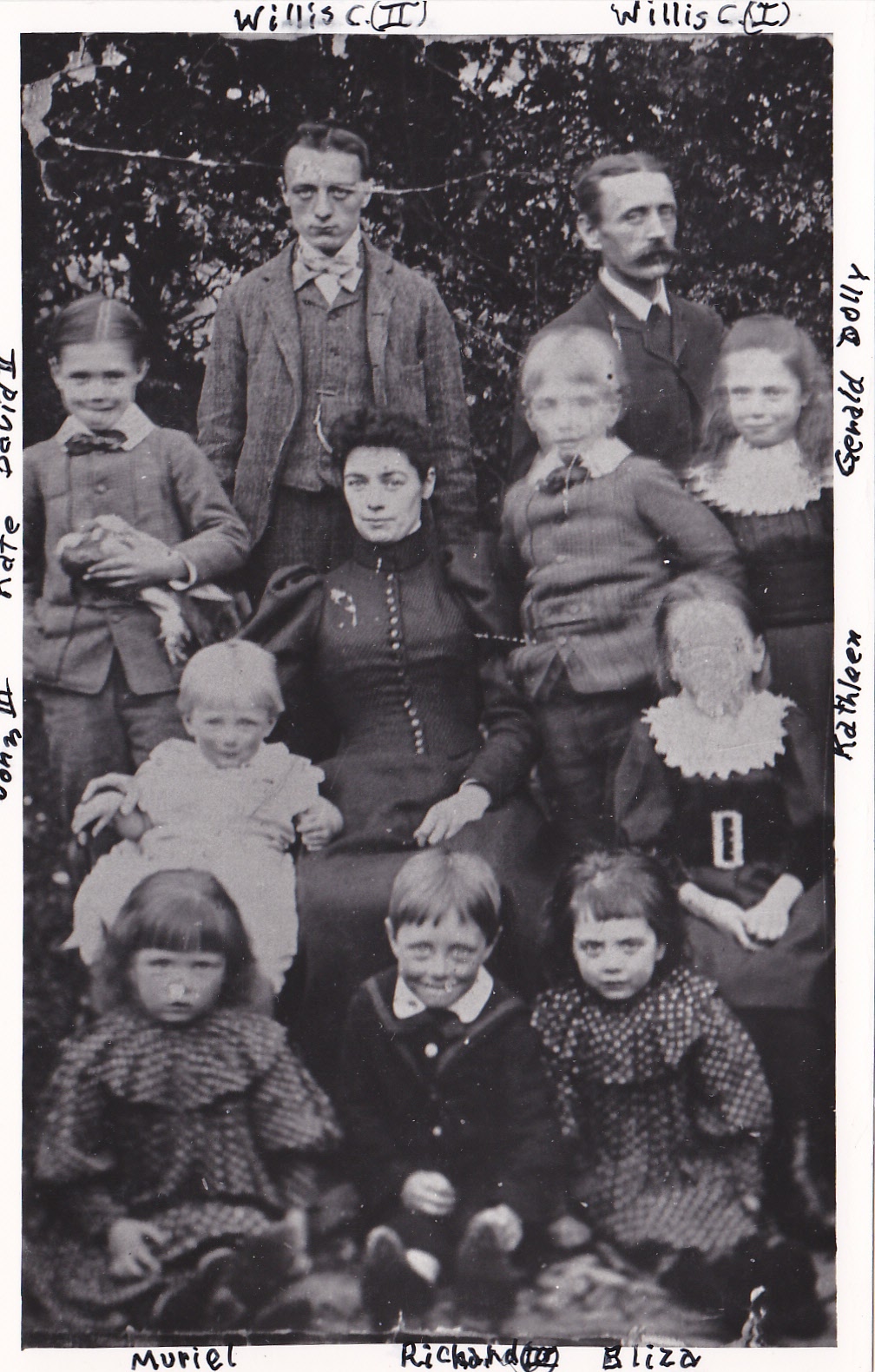


The children of Kate O'Neill and Willis Creighton Williams were as follows:

Willis Creighton Williams II, born circa 1875?
David Creighton Williams, born Everton, Liverpool on 31st May 1882.
Eveline Nina (Dolly), born June 1883.
Gerald O'Moore Williams, born circa 1884 - 1885.
Jessie Muriel, born 25th April 1886; she died 25 days later.
Kathleen Willis, born circa 1887 - 1888.
Richard, born May 1889. (Our maternal grandfather.)
Eliza Willis (Lil), born July 1890.
Muriel, born 11th September 1891.
John, born circa 1892 - 1893.
George Willis, born circa 1899 - 1900.

Willis Creighton Williams II, who the children regarded as their older brother and who died of typhoid fever aged 25.  It is believed by earlier members of my mother's family that Willis had been adopted at an early age by Willis and Kate.  I have no idea if this is true or not.  It appears that he had been born about 1875 - 6, several years before his parents' marriage although this in itself doesn't signify adoption. His date of birth was worked out from information on his death certificate and it's important to state that few people at this time actually knew what their real date of birth was.  Whatever his date of birth, he bears a striking resemblance in the above photo to one of our maternal Williams uncles.  Perhaps he had been born prior to the marriage of his parents, which might explain why Willis and Kate hadn't married at home in Dublin;  alternatively, he may have been born to one of his paternal or maternal aunts and have been adopted later by Willis and Kate.  I can find no record of his birth, but the 1901 Census states that he'd been born in England somewhere.

The younger Willis Creighton Williams worked in the Bank of Ireland in Limerick and then in Dublin, as did so many members of the Williams family. (My grandfather Richard Williams also worked for the bank as did his brothers John, David Creighton and Gerald O'Moore. On the 1911 census, they describe themselves as 'gentlemen' bank officials.) He was an enthusiastic musician and taught music; it is said he used a dummy piano to practice on.

The 'Dublin Daily Express' of 27th August 1894 noted W. Creighton Williams as Registrar of Sir Patrick Dun's Hospital. This job concerned finance rather than medicine, and this would be an appropriate position for a bank clerk.  This W. Creighton Williams was either the son, born 1875, or the father.
Later, the 'Dublin Daily Express' of 21st December 1898 reported that the London College of Music had held its Dublin exams in Molesworth Hall, Dublin, and that, in its senior section, W. Creighton Williams Junior, a pupil of W. Creighton Williams, had received an Honour.  In  the elementary section were pupils of Miss Bolton, Miss Williams and Miss Creighton, relations who ran a school, Kenmare House in North Great Georges Street.

In 1901 Willis Creighton Williams Junior was a boarder at 16 McMahon Street and, interestingly, gave his religion as Church of Ireland - the rest of his immediate family were Plymouth Brethren baptists. He died, aged 25, on 26th September 1901 in the Adelaide Hospital, Dublin, of typhoid fever and is buried in Mount Jerome Cemetery.

The Williams family were staunch members of Merrion Hall, the meeting place in Merrion Square of the Dublin Plymouth Brethren. Although Kate O'Neill had most likely converted from Catholicism, she was remembered as a mother who was keen on teaching the bible to her children.  The family would walk from their home in Sandyford to attend religious services in Merrion Hall, now the Davenport Hotel.


In 1910, the family were living at 50 Park Avenue, Sandymount.  On the 1911 Census, under 'occupation', Willis described his profession as 'gentleman bank official', while the working boys were described as gentlemen clerks etc.

Kate O'Neill died at home - 38 Grosvenor Square - from chronic pulmonary tuberculosis on 17th February 1920, aged about 60 or 61.

After his wife's death, Willis Creighton Williams continued to live on at the family home along with several of his unmarried children, but eventually succombed to senile dementia and ended his days in a nursing home called 'Bloomfield' in Donnybrook.  He died on 22nd October 1932, aged about 75 or 76.  He is buried in Mount Jerome Cemetery:
   'Family Burial Place of Willis Creighton Williams
    Jessie Muriel Williams (Junr)  died 20th May 1886
    Willis Creighton Williams (Junr)  died 26th September 1901
    Emily Williams     died 8th October 1914
    Kate Williams      died 17th February 1920
    Willis Creighton Williams  died 22nd October 1932
    John Williams     Killed in France   October 1918'


Hutchins Thomas Williams

Hutchins Thomas Williams (1790 - 1839):

NB: I keep returning to this post to edit the details as I discover more information about members of this Williams family.  I am not related to them but needed to rule out a family link.  

Thomas Hutchins Williams was born to John Jeffery Williams and Sarah Dignan in Holborn, London, and was baptised on February 20th 1790 in the Church of St. George the Martyr - his older brother, John Dignan Williams, ended up in Dublin and also had close association with the CDSPCo. which had been founded by the sons of Thomas Williams of the Bank of Ireland, who were the cousins of Hutchins' father John Jeffery Williams.
Thomas Hutchins Williams later called himself Hutchins Thomas Williams.  As well as an older brother, the merchant of London and Dublin, John Dignan Williams, he had a sister, Sarah Williams who married a Rev. Archibald.  When Hutchins was living at 39 Dame Street, in the 1820s, he had a sick sister living there with him and this was possibly Sarah.  A sister, Harriet, may also have survived childhood, but she wasn't mentioned in her father's will of 1815 - if she survived, then I haven't come across her.
Following his mother's death, Hutchins father married Mary Oliver of Alresford, Essex, and had a further three children with her - Richard,  Henry who married Eliza Richer in 1840 but who disappears from the records at that stage, and Mary who married Rev.Samuel Farman in 1835.

 In 1818, Hutchins Thomas Williams, public notary, petitioned the Lord Lieutenant, Lord Talbot, of Dublin Castle, requesting the grant of a licence to operate as a stockbroker. The petition stated that he was a partner in the firm of Gibbons and Williams, and he included the names Arthur Hume and Nathaniel Callwell to act as joint sureties:
   'To His Excellency Charles Earl Talbot, Lord Lieutenant General and General Governor of Ireland,  The Memorial of Hutchins Thomas Williams of the City of Dublin, Public Notary, Sheweth That your Memorialist is a Public Notary and co-partner in the firm of Messrs Gibbons and Williams, Practising Public Notaries and Stock Brokers in said city of Dublin.    That your Memorialist is desirous of a License to act as a Stock Broker and proposes Arthur Hume and Nathaniel Callwell Esqrs. both of the City of Dublin aforesaid as Sureties jointly with the said Hutchins Thomas Williams to the amount and for the purposes required by Act of Parliament for licensing Stock Brokers.
   We the undersigned do hereby certify that we know Hutchins Thomas Williams above named and think him a fit and proper person to be licensed as a Stock Broker.'
     Of the list of signatures, I could only make out several of them with any great certainty - G. La Touche (of the Dublin banking family), Newcomen (also of a family of Dublin bankers), Joshua and Joseph Pim (merchants and bankers), and Joseph Goff (an early director of the Bank of Ireland).  Given what Hutchins got up to a few years later, they all probably lived to regret giving their names as a reference!

Pigot's Directory of 1824 shows Hutchins Thomas Williams living at 4 Belvedere Place; he appears there under the entries for 'Nobility and Gentry' and for 'Notaries'. Earlier in 1815, The Treble Almanack showed the family of Thomas Williams of the Bank of Ireland living at 2 Belvedere Place.
In 1827, it was noted that Hutchins Thomas Williams held £4400 worth of stock in the City of Dublin Steam Packet Company. An earlier list of proprietors of 1824 gives his address at the time as 4 Belvedere Place - the family of Thomas Williams (of the Bank of Ireland) earlier lived at 2 Belvedere Place.

In 1829,  H.Thomas Williams, a merchant, was admitted by Grace Especial to the Freemen of Dublin.

http://alison-stewart.blogspot.ie/2012/02/law-case-involving-hutchins-thomas.html

A deed of 1833 (1833-6-103) details the transfer of a property on Ellis Quay, and involved Richard Williams and Hutchins Thomas Williams of Dame Street;  also mentioned was the gentleman and solicitor of College Green, who may be the brother of Hutchins Thomas Williams.  This same William Williams witnessed an earlier deed (886-120-586622) of 1832, whereby land in Friarsland, Queen's Co., owned by a James Lafarelle, was being transferred to Hutchins Thomas Williams.    That same year, 1832, yet another deed (886-120-586623) details the transferral of a house on Baggot Street, and once again the parties involved included Richard and Hutchins Thomas Williams of Dame St., and William Williams of College Green.

In 1832, Hutchins Williams of 38 Dame Street was noted as a churchwarden of St.Andrews Church.
On 26th April 1833, Dympna Elis of Woodville, North Liberties, Cork, leased a house on the northside of Merrion Square, Dublin, for the remainder of 92 years to Hutchins Williams of Dame Street. The rent was £100 per annum.  This was No. 9, Merrion Square, later owned by Michael O'Leary of Ryanair.

From Hazel Smyth's 'Some Notes on Charles Wye Williams, His Family, Their Life and Times' (published by the Dublin Historical Record), we read the following:
'The Skeleton in the Cupboard Williams - Hutchins Thomas lived at 4, Belvedere Place where his wife gave birth to twin daughters; thence moved to Dame Street; 9 Merrion Square; "Bloomfield", Bird Avenue; was declared an "Outlaw"....'

From "The Bankers' Magazine, Volume 3", I discovered that, on January 21st 1835, Hutchins Thomas Williams of Dame Street, banker, stockbroker and public notary, trading under the firm of Gibbons & Williams, had been declared bankrupt.

An 1835 edition of 'The Law Recorder, Volumes 3 - 4' gives some details.
'In the matter of Hutchins Thomas Williams, a Bankrupt. The petition stated that H.T.Williams had been duly found and declared a bankrupt....that Elizabeth Oliver attended a meeting...for the purpose of proving a debt...and thereupon deposed that the said H.T.Williams, trading in partnership with Richard Williams, was, together with his said partner....indebted to her in the sum of £250, being the balance due to her on foot of an account for money...to and for the use of the said Elizabeth Oliver, and in the further sum of £1845, being the value...of forty-five shares of and in the Provincial Banking Company, charged to her on the said account, as having been purchased for her by the said co-partners...but which shares had not been transferred to her or entered in her name in the books of the said Provincial Bank....That the said Richard Williams was still in solvent circumstances.....
....The grounds on which Elizabeth Oliver rests her claim are, that she entrusted the said co-partners with several sums of money, from time to time, with directions to invest the same for her in the purchase of shares in the Provincial Bank; that they furnished her with an account, charging her with the purchase of several shares purchased from time to time for her: that previous to the bankruptcy of the said H.T.Williams, the said ex-partners had dissolved their partnership, without notice to her of the intended dissolution; that she had never heard of the same until after the said bankruptcy and that she has since discovered that, though in the said account she had been charged with the purchase of such shares, that in fact no such shares had been entered in her name in the books of the said Provincial Bank. '

Following the bankruptcy, Gibbons and Williams had debts of £70,736 11s, although a separate report stated that the debts were in the region of £200,000, while the firm's assets were a paltry £45,000.  Gibbons and Williams had dealings with several prominent London businesses at the time of the company's collapse in 1835.   I wonder who the aggrieved Elizabeth Oliver was?  Could she be a relation of Hutchins' step-mother, Sarah Oliver, who was the second wife of his father, John Jeffery Williams?

From The Evening Post of 1835: 'Extract of a letter from Dublin, dated January 21: "The utmost consternation prevailed through Dublin, today, owing to the unlooked for failure of the well-known house of Gibbons and Williams, of Damestreet. In addition to the banking business, they carried on that of stock-brokers and notaries public." '


From 'The Times' of 26th January 1835:   'Failure of Messrs. Gibbons and Williams.  A confidential messenger belonging to the establishment proved the act of bankruptcy, which was, that a Mr. Duffy, one of the creditors, had called to demand some money due to him, and that Mr.Hutchins T. Williams was at his own special desire denied to Mr. Duffy....we are requested to state that James Gibbons, Esq., of Ballinagall, county of Westmeath, was not in any manner whatever, connected with the firm trading under the name of "Gibbons and Williams" in this city, whose failure was announced yesterday...Today at three o' clock, I attended the opening of the commission at the Royal Exchange, to see Hutchins Thomas Williams declared a bankrupt.  The docket was struck against him alone....The business was done...in a very quiet manner. Two clerks and the porter of 39 Dame-street, proved the trading and closing of the doors at half past ten in the morning of yesterday, and the denial of Mr. Williams...to those who came with notes to be exchanged.  It was remarked that Mr. Creighton (barrister to the commission and a friend of Mr. Williams) examined the witnesses in almost a whisper and that their depositions were brought already written out....'

From 'The Belfast Telegraph', 27th January 1835:  'Failure of Messrs. Gibbons and Williams' Bank of Dublin - A complete panic pervaded the mercantile interests of this city on Thursday at the closing of this house, so long deemed of the highest character, credit and respectability.  There are various rumours as to the amount to which the firm are liable, some say £300,000 - others only £40,000.  The paper of the bank is said to have obtained a large circulation in the county Westmeath, where the estate of one of the firm is situate.  It is thought that all the liabilities of the bank will be met to the satisfaction of the creditors,  as there is a large amount of available debits due to the firm.'

From 'The Spectator' of 24 January 1835 : 'Gibbons & Williams : The banking-house of Gibbons and Williams of Dublin stopped payment on Wednesday. The amount of their out-tending engage- ments is stated at 800,1a10/. The Dublin correspondent of the 'Linnet says—" Gibbon and Williams had a good many of their notes pushed into circulation amongst the farmers, particularly in the county of West- meath, where an estate of theirs lies, and also amongst the shipping interests. I hear that one Dublin house is in for 60,0001., and a house in Liverpool for 23,000/. '


NB: The above two reports seem to confirm that the James Gibbons, who was in business with the Williams family at their premises in Dame Street was, indeed, James Gibbons of Ballynagall, Westmeath, although the younger James Gibbons had left the partnership prior to the collapse of Hutchins' business.

It seems that James Gibbons had been in partnership with Richard Williams earlier in the century (the business of Gibbons and Williams first appeared in the street directories in 1799), but at 38 Dame Street, rather than Hutchins' address of 39 Dame Street next door. In the Almanac of 1815, it was noted that James Gibbons and Richard Williams, of 38 Dame Street, were public notaries. At the same address, also in 1815, James Gibbons and Richard Williams operated a separate business together as stockbrokers.

It is known that, two years prior to Hutchins' bankruptcy of 1835, that Hutchins and Richard Williams had been in business together, trading under the name of 'Gibbons and Williams', but that Richard and Hutchins had dissolved the partnership in about 1833.  James Gibbons had already left the business by 1833.  Following the split in partnership in 1833, Richard Williams resumed operations, trading under the new name of Richard Williams & Son, while Hutchins Thomas Williams continued to use the older name of Gibbons and Williams.  He had an apprentice named Gibbons, and two business partners, C. Copeland and R.M. Powell.

UPDATE:  I accessed a useful deed which clarifies things - I didn't note the reference code from the index book, but the deed itself was dated 23rd May 1821, and concerned the dissolution of the partnership between James Gibbons, Richard Williams, Thomas Gibbons and Hutchins Thomas Williams. The four men had carried on the business of notaries public, stockbrokers, British Exchange brokers and general agents, as co-partners, under the name of 'Gibbons and Williams'.  In 1821, they agreed to dissolve the business - a new one was being founded by Richard Williams, Thomas Gibbons and Hutchins Thomas Williams.  James Gibbons was, therefore, leaving the business in 1821.

By 1846, Slater's Commercial Directory notes Richard Williams & Sons, Notaries for the Bank of Ireland; Richard Williams & Sons, Stockbrokers of 38 Dame Street; also Richard's son, Richard Palmer Williams, notary of 38 Dame Street.  (Richard Williams was also the owner of the neighbouring No. 39.)

Ralph's Stock and Share Brokers' Directory of 1853 lists Richard Williams & Sons of 38 Dame Street, the sons being Charles Watkin Williams, Thomas Williams and Richard Palmer Williams.

Hutchins Thomas Williams was married to Francis Susanna Carleton. (Francis Susanna's parents, Peter Carleton and Margaret Griffin married in St. Andrew's Church in 1784 and subsequently had 10 children.) In Dublin Hutchins Thomas Williams and Francis Susanna had - according to the LDS website - nine children: the twins, Charlotte and Sarah, John, Margaret, Hutchins, James, Eliza, Frederick and Anne.
http://alison-stewart.blogspot.com/2011/11/carleton-family-of-eustace-street.html

Hutchins Thomas Williams and his wife emigrated to Simcoe, Ontario, via New York. There are two separate  records for them, arriving in New York City in 1835. The first merely mentions that Hutchins Thomas Williams arrived there in 1835; the second document is the manifest of the 'Silas Williams' which shows Hutchins' family arriving in the city on May 25th 1835:
    'Mrs. Williams and servant
     Master John Williams
     Miss Fanny Williams
     Master James Williams
     Miss Charlotte Williams 
     Miss Sarah Williams
     Master Hutchins Williams
     Miss Nanny Williams
     Miss Harriet Williams
     Master Frederick Williams.'

Their farm in Canada was named Brookeville. In 1875, the widowed Eliza Loundes, the daughter of Hutchins and Francis Susannah Williams married the barrister John Henry Ansley, in Simcoe. Eliza had been born in Dublin in 1825.  Neither Eliza nor her father, Hutchins Thomas, appear on the manifest of the 'Silas Williams' above - I wonder was one of the pages missing?

Hutchins' son, James Gibbons Williams, a yeoman of Townsend, Simcoe, married Annabella Caroline Lowndes of Woodhouse, on 1st February 1849.  The witnesses were John G. Williams (James' brother?) and Charles William Covernton.

Dr. Charles William Covernton married Frances Elizabeth Williams, the daughter of Hutchins Thomas Williams, in 1841 in Woodhouse, Longpoint, Canada, while Frances' sister, Sara Williams, married Dr. Charles Williams Covernton's brother, James Covernton, on 6th December 1851.

The photo below shows Dr. Charles William Covernton and was kindly donated by Les Underwood, whose wife, Penny Underwood, is the great-great granddaughter of Charles William Covernton.  The second photo shows William Hutchins Covernton, the son of Dr. Charles William Covernton and Frances Elizabeth/Fanny Williams.  William followed his father into the medical profession, and served with the Union army during the American Civil War before emigrating to Argentina and starting his own branch of the Coverntons there

Dr. Charles William Covernton

William Hutchins Covernton


On 5th January 1875, in Simcoe, James Gibbons Williams witnessed the marriage of David Thomas Dunscombe to Catherine Eliza Loundes, daughter of George and Eliza Loundes - James was most probably the son of Hutchins Thomas Williams - he was named, therefore, after James Gibbons who had been in business at 38 Dame Street, Dublin, with the Williams family.
James Gibbons Williams died in Simcoe on 27th January 1882; he had been born in Dublin in 1821.

On 3rd September 1857 in Simcoe, Mary Williams, the youngest daughter of the late Hutchins Thomas Williams of Dublin, married Charles West of Toledo.

From St. John's Anglican Church Cemetery, Woodhouse Township, Norfolk County, Ontario, Canada:
'In memory of / Frances Susannah / relict of the late Hutchins T.WILLIAMS / a native of Dublin, Ireland / who departed this life September14, 1844 / aged 50 years and 5 months
Sacred to the memory of / Hutchins T. WILLIAMS / who departed this life/ 16 February 1839 / aged 47 years.'


From Deed 1840-8-74:   On 15th April 1840, Richard Williams of Dame Street made 38 Dame Street over to George Simpson Carleton at a yearly rent of £100 for the life of Frances Susanna Carleton, then of Simcoe, Canada, the widow of the deceased Hutchins Thomas Williams.

On 26th July 1866, at the parish church of Snettisham, Norfolk, England, Hutchins Williams, MRCSE, LRCP.ed etc., surgeon of the Peninsular and Oriental Company's service, son of the late Hutchins Thomas Williams, Esq., of Dublin, married Ellen Harriet, the daughter of the Rev.John Coldham, the vicar of Snettisham.   Two of his sisters also married two of his wife's brothers - Charlotte Williams married Henry Coldham while Annie/Nanny Williams married Dr.James Coldham.

Hutchins Williams Junior appears on the 1881 England and Wales Census. He had been born in 1845 in Dublin. In 1881 he was living with his wife, Ellen, and his son Egerton H.J.Williams (born 1871) , at 'Bloomfield' (named after his childhood home in Dublin?), Lee, Kent, England. He gave his occupation as a general practitioner and physical surgeon.
By 1911, he was living at Charleton and Kidbrooke, Blackheath, London and was aged 83.

Richard Palmer Williams, son of Richard and Anne Williams

I am not related to this Williams family but researched them in order to rule out a family link - I include the research here for the benefit of fellow researchers.

Richard Palmer Williams was the third child of Richard Williams and the nephew of Charles Wye Williams. He worked alongside his father and older brother, Thomas, at their premises of 38 Dame Street, directly across the street from the Bank of Ireland headquarters.  He was born in 1813 and died a bachelor, aged 79, on the 12th of May, 1892. 
     'Williams, Richard Palmer of Glaslinn, Clontarf, County Dublin, esq., died 12th May 1892. Probate Dublin to Richard Williams Barrington esq., and Croker Barrington, solicitor. Sealed London 15th August. Effects £2206 in England.'

Although Richard Palmer Williams worked in finance all his life, his real passion was natural history.

Richard Palmer was elected a member of the Royal Irish Academy on January 14th 1839;  earlier, in 1837, his brother, Thomas, had also been elected to the R.I.A. as had his sister's father-in-law, Matthew Barrington.  The archives of the Academy for 1847 - 1850 note both Richard Palmer and Thomas as living in Drumcondra Castle and gives their business address as 38 Dame Street.  Charles Wye Williams (their uncle) appears on the same list, and gives his address as Liverpool.

Throughout his life, Richard Palmer was also a committed member of the Dublin Natural History Society and his names appears constantly throughout their archives.  In 1855, for example, 'Mr. R.P.Williams requested permission to notice a fine specimen of the Iceland Gull....which had been presented to the society through Joseph Todhunter Esq., from Dr.Harvey of Cork.'
    Also:  'R.P.Williams read a letter about the occurence of two Hoopoes, shot in County Cork, and also wished to record the occurence of a turtle dove seen in a potato field between Howth and Baldoyle on 9th July 1854.'
    The same text records that R.P.Williams accompanied Mr. William Andrews to Carlow to study parr in the River Greece.  Williams had already collected and studied fish in the rivers of Cork and Wicklow,  in particular on the Bandon River.
In 1857,  the Joseph Todhunter, mentioned above, was on the Council of the Dublin University Zoological and Botanical Association;  Richard Palmer was the treasurer.  Joseph Todhunter was a close relation of Thomas Harvey Todhunter who had gone briefly into business with our great-great-grandfather, Richard Williams, in 1846 at 17 Eden Quay.
Dr. Harvey was Dr. Joshua Ruebens Harvey, a naturalist of Co. Cork.
Richard Palmer William's friend, William Andrews, 1802 - 1880, was an English naturalist who was the secretary and president of the Dublin Natural History Society. A variety of the Killarney fern - Andrewsii - is named after him.

Richard Palmer Williams made copious contributions to the Natural History Society in 1866 - he commented on the abundance of brimstone butterflies in Killarney. He was only aware of two specimens, one in his own collection, which had been sourced on his behalf by Mr. Heffield, and one or two in the collection of the late Mr. Tardy, now in Trinity.  He mentioned that both Mr. Hefflied and Mr. Tardy had been frequent campanions on his etymological expeditions.
At the same meeting, he contributed to a discussion on diseases of goldfish (his own),  and read a paper on the remarkable change of colour in a fowl of the Hamburgh Breed....'Gentlemen,  I beg leave to bring before your notice this night a remarkable change of plummage in a hen of the Hamburgh breed, which is painfully recorded in my mind, from the fact that, by whatever affected, whether fright or otherwise, I lost the chance of the silver cup in the crested class at the last Liverpool show in January last.' 

'The Journal of Horticulture and the Cottage Gardener' of 1868 records Richard Palmer Williams' true passion:
  'For Sale Rare Waterfowl - One pair of Ruddy Shelducks, tame bred, and properly pinioned, second prize at Wolverhampton, price £6 6s;  One Male Ruddy Shelduck, £3 3s;  One Female Bahama Duck £3 3s;  One Male Barnacle, tame bred, £1 10s;  On Receipt of a Post-Office Order on Dublin, Mr. Richard Palmer Williams of Glaslinn, Clontarf, Dublin, will forward the Birds.'
  
 'Richard Palmer Williams, Glaslinn, Clontarf, Dublin, on receipt of an order from Dublin, will supply eggs from poultry, winners last year at Wolverhampton, Birmingham, Dublin, Limerick and Cork at 13s per dozen.  Dorking (Silver and Dark Grey), Spanish, Gold and Silver Polands, Rouen Ducks, Aylesbury Ducks.  For Sale, Two Gold Poland Cockerels, sons of First Prize Cock at Birmingham, brothers to the Third Prize Bird, £2 2s each;  a pair of Ruddy Shelducks £5 5s;  one Ruddy Sheldrake £2 10s.  WANTED,  an Ashy-Headed Magellan Gander.'


Address 1880:  Glaslinn, Hollybrook Park, Raheny, Dublin.

Charles De La Valade


The Huguenot refugee, Rev. Charles de la Valade, became the pastor of the French Church in Lisburn in 1704, a post he held for 40 years. He died in 1756 - if he died at the age of about 80, then his date of birth would have been circa 1670.

The Lavalade name in Ireland only occurs in the Lisburn/Dromore area.  Spelt phonetically for the most part, there are a variety of different spellings.  Our paternal great-great-great grandmother was named Agnes Lavalet/Lavalade and married our great-great-great grandfather, Reid Wilson, in Ballygunaghan, Donaghcloney, just south of Dromore, Co. Down, in about 1826.

It's important to clarify that I have found no link between the first of the French Lavalade family to settle in the Lisburn/Dromore area of Northern Ireland, Rev. Charles Lavalade, and the cluster of Lavalades who lived in the Dromore/Donaghcloney area, but since the name only occurs in this one particular area, I would suspect that a family link is likely.   In January 2017 I received the results of an Ancestry DNA test which revealed that I share an early genetic link with a fellow researcher who descends from the Crommelin/de la Cherois family of Lisburn and Donaghdee.  The sister of Rev. Charles Lavalade of Lisburn was Madeleine de la Valade who married Alexander Crommelin, a member of the Lisburn Crommelins.

Where did the Rev. Charles Lavalade originate in France?   The name of the family was de Lavalade/de Lavallade/de la Vallade/de la Valade. There was no nom de terre added to it.  Having researched as many of the La Valade families as I could find, via the Geneanet website which holds a large online collection of original French historical material in their library,  I isolated the staunchly Protestant ones, and none of these had a ‘nom de terre’ attached.
I isolated the staunchly Protestant Lavalade families in the southern part of the country, ruled out many, and concentrated eventually the families of Bertrand de Lavallade of Nerac who was the attorney general of Henry IV of Navarre,  and the family of the Protestant pastor, Pierre de la Vallade of Fontenoy-le-Conte.  Both Betrand de Lavallade and Pierre de la Vallade are well-documented and lived in the Languedoc area, which in earlier times generally referred to much of the South of France, and Rev. Charles de la Valade of Lisburn was reputed to come from this same area of the country.

In 'Recherches Historiques et Archaeologiques sur Fontenoy'  Bernard Fillon states (page 254) that Pierre and Bertrand de La Vallade were of the same family...'Pierre de la Vallade, né dans le Languedoc, d'abord ministre a Bergerac, s'acquit beaucoup de réputation...Pierre de la Vallade etait parent de Bertrand de la Vallade, conseiller du roi de Navarre...'
 The following links give details on these two earlier Protestant French Lavalades...


http://alison-stewart.blogspot.ie/2011/08/more-on-pierre-and-bertrand-de-la.html

The siblings of Rev. Charles de la Valade/Lavalade also fled France.  He was known to have one brother, possibly named Alain, who supposedly succeeded him in Lisburn Cathedral for two years, and six sisters. Four of his sisters remained unmarried and settled in the Lisburn area -  they were named  Ann, Martha, Catherine, and Judith Lavalade.
The fifth sister of Rev. Charles de la Valade, Magdalen Lavalade, married into the Crommelin family who were the founders of the linen industry in Lisburn.  I recently - in January 2017 - took an Ancestry DNA test, which revealed that I'm a distantly related to the Crommelin family.  This would seem to suggest, therefore, that the Donaghcloney Lavalades were relatives of the Lisburn Lavalades, although I have found nothing to shed any further light on the family link.

Charles de la Valade's sixth sister married into the Dubourdieu family.  Her first name is unknown, although she might be the sister, Madeleine, who married Alexander Crommelin of Lisburn as a second marriage.

The Dubourdieu family originated in Bergerac and fled France, settling eventually in London where they were closely linked to the French church there.

Rev.Isaac Dubourdieu (1567 - 1700) had been born in Bergerac to Pierre Dubourdieu, the governer of Bergerac.  Rev. Isaac Dubourdieu would die in London. By his first wife, presumably a La Valet although some sources suggest she was a Lavalade, he had two children:

1)Andrée La Valet Dubourdieu who married, firstly, Jean Vachan, and, secondly, Jean Boisbellaud de la Chapelle. They were the parents of the pastor Armand Dubourdieu Boybellaud de la Chapelle. Jean Armand Boisbeleau de la Chapelle was called from London, where he had been the pastor of the Church of the Artillery, to the Walloon Church in La Haye, Holland, where he was installed on 11th November 1725; he died in 1745.

2) James/Jacques Dubourdieu (1621 - 1682ish)  who married the older sister of Charles de la Valade/Lavalade.  He was murdered just before the revocation of the Edict of Nantes, possibly in Blaye or Montpelier. (There is a record of a Jacques Dubourdieu attending the Synod of Charenton in 1644;  he was noted as an elder of the church at Blaye.  Our Jacques Dubourdieu would have been 23 years old in 1644.)
The son of Jacques Dubourdieu and his wife née Lavalade, was Jean-Armand Dubourdieu (1683 - 1723) who would later marry Charlotte Massy - their son was Rev. Saumarez Dubourdieu, the celebrated third pastor of the French Church in Lisburn who succeeded his great-uncles, the two Lavalade brothers, Charles and Alain.

The second wife of Rev. Isaac Dubourdieu was Marie de Costebadie, the daughter of the minister Jean de Costebadie. They married in 1660 and had four sons. One of them, Jean Dubourdieu, helped to organise the escape of many French Protestants from the county, including the widow  - Charles de la Valade’s sister - of his murdered half-brother, Jacques, and her baby son Jean-Armand, who would take refuge with the Rev. Isaac Dubourdieu in London.
Rev. Isaac Dubourdieu was transferred to the Reformed Church in Montpelier in 1651 and was exiled to London in 1683 where he became pastor of the French Church at the Savoy.
A Dubourdieu,one of the pastors who succeeded Isaac Dubourdieu at the French Church in the Savoy in London, appears many times in the Calendars of State Papers in Whitehall as the person who recommended that a travel pass be awarded to French Protestants wishing to travel from London to, for the most part, Holland.
This particular Dubourdieu  may well have been Isaac Dubourdieu’s grandson, Jean-Armand Dubourdieu, who had been born to Isaac’s son, James/Jacques Dubourdieu and his La Valade wife in about 1680.  James Dubourdieu was murdered in France in about 1682 - but it’s unclear where but possibly in Montpelier - which prompted his widow’s escape to London in 1683, aided by her brother-in-law Jean Dubourdieu.  Madame Dubourdieu ‘walked the entire width of France, from near the Atlantic to Switzerland….the Count’s daughter enlisted the services of a faithful domestic, disguised herself as a peasant, put her infant son in a shawl on her back, and set off on her long long journey.’  (From ‘Baby on Her Back’ by Rev.William J. DuBourdieu.)
From the safety of Switzerland, she entered Germany, then Holland, and finally London where they were taken in by the patriarch of the family, Rev. Isaac Dubourdieu.

Madame Lavalade Dubourdieu and her young son, Jean-Armand Dubourdieu, were shortly joined in the same London household by Jean-Armand’s two cousins, Armand Boybellaud, who was the son of Andrée La Valet Dubourdieu and Jean Boybellaud de la Chapelle, and by J.Armand Dubourdieu.  All three cousins were educated and reared in the home of their grandfather, Rev. Isaac Dubourdieu.

Rev. Charles de la Valade escaped from France to the safety of Protestant Holland and settled at Haarlem where Samuel Crommelin and his wife, Madeleine Testart had also settled following their expulsion from St. Quentin.  Charles' sister, Madeleine de la Valade, married their son, Alexandre Crommelin;  the young couple spent time in Hamburg before moving to Lisburn.  The sister of Alexandre Crommelin, Anne Crommelin, had married her cousin, Louis Crommelin, who was the founder of the linen industry at Lisburn, and it was Louis Crommelin who suggested Charles Lavalade as a possible pastor for the French church there.

The following document, sourced from ‘The Pedigree Register, Vol.2’, documents later legal wrangling by the Crommelin family, and makes mention of the Lavalade sisters - Magdalen/Madeleine Lavalade who married Alexander Crommelin, and the unmarried sisters, Ann, Martha, Catherine and Judith Lavalade:

'Cramer V. Steward:  1790, July 5th.  Marmaduke CRAMER only child and heir at law of Balthazer CRAMER v. Poyntz STEWARD and Ann, his wife,  late wife of Abraham CROMMELIN. WILL OF ALEXANDER CROMMELIN OF LISBURN, Co.Antrim in Ireland, dated 19th April 1735, his wife Magdalen and daughter Martha executrixes. Testator died 2nd December 1737. Marriages articles 29 July 1741 between late plaintiff Balthazar CRAMER and said Martha CROMELIN, who died and adm’on of her effects was granted 9 March 1741 (sic for 1741/2) to the said Balthazer. His marriage in 1743 with Elizabeth STEPHENS, marriage articles 22 Sept. 1743, between him, Ambrose CRAMER, William STEPHENS Doctor in Physick, and the said Elizabeth his daughter,  trustees Brewster LAUGHLIN and  Walter STEPHENS. Annuities left by testator Alexander CROMMELIN to Magdalen CROMMELIN, Charles CROMMELIN, and Ann Martha Catherine, and Judith LAVALADE.  That by the affidavid of Anne Maria STEPHENS, sworn 28 April 1790 at New Ross in Ireland it appears that the said late Balthazar CRAMER and Elizabeth had three children born of their marriage, viz., two daughters who died in their infancy and one son, the present plaintiff. That the late plaintiff, Elizabeth CRAMER died in January 1783 and was buried at St.Mary’s, Ross, Co. Wexford, leaving the said Balthazer her surviving, who also died 22 December 1783, intestate, leaving the present plaintiff Marmaduke, the only child of the said marriage, in whom the remainder in fee of the estate to be purchased is vested.’

The original will of Alexander Crommelin was published in 'Huguenot Wills and Administrations of England and Ireland, 1617 - 1849':
  'Alexander Crommelin, of Lisburn, wife Magdalen, daughter Matty, son Charles Crommelin, annuity for sisters-in-law, Anne, Martha, Catherine and Judith Levallade, to daughter Magdalen and her husband Rev. Francis Hutchinson 65/- and no more, nephew Paul Mangin £20. Executrixes wife and daughter. Dated 19 April 1735. Probate 15th December 1737.'

http://alison-stewart.blogspot.ie/2012/02/notes-on-alexander-crommelin-and.html

Sightings of Charles de la Valade:

On 1 Sept. 1690,  the English authorities granted travel passes to Charles and Madeleine de Lavalade to travel from Harwich, north of London, to Holland:
'Passes for John Watson, his wife, and three children to go to Chester for Ireland; for Peter Doorn, Jasper de Vries, William Rechtering, Cornelis de Clerk, and Nicholas Vanderstar to go to Harwich for Holland; for Charles Lavalade and Magdalen Lavalade, his sister, ditto; and for George Boscher, ditto. [Ibid., pp. 363, 364.]'
  (From 'Calendar of State Papers Domestic: William and Mary, 1690-1)

Charles died in 1756; if he was aged about 85 at the time of his death, then his date of birth would be about 1670, which would make him 20-ish when he travelled from London to Holland in 1690 and was confirmed in Haarlem in 1699.

From 'La Confession de Foy des Eglises Reformees des Pays-Bas',  which details the synods of the Protestant Church in Holland, I discovered a reference to our Charles de la Valade, who was present at the Synod of Middlebourg on September 4th 1699.
  'Charles Lavallade, appellé a l'Eglise de Lisburn en Irlande; confirmé par l'imposition des mains, dans le meme synode, par Mr. Prevost, Pasteur de l'Eglise de Haarlem.'  ('Charles Lavallade, called to the Church in Lisburn, confirmed with the laying-on of hands at the same synod, by Mr. Prevost, the pastor of Haarlem'.)

Charles Lavalade had been confirmed in Haarlem by the pastor, Jean Prevost, who had been called to the church from Dordrecht in 1671 as the second pastor, becoming the head pastor there in 1689 and dying in 1715.
I scoured the records of the Walloon Church, ie: the Reformed or Protestant Church, in the Netherlands but there was no mention of Charles Lavalade working as a pastor there; perhaps he was merely a member of the congregation prior to his confirmation by Jean Prevost in 1699. His older sister was living with her son, Jean-Armand Dubourdieu, with Rev. Isaac Dubourdieu in London at this time, while his younger sister, Madeleine had married Alexander Crommelin and was living at Haarlem and then Hamburg at this time - Charles may have been moving between England, Holland and Germany, before settling finally in Lisburn.

In the same year, 1699, he was apparently noted in the register of the French Church of Threadneedle Street in London, although I haven't seen this record.

The 'Livre Synodal Contenant les Articles Résolus dans les Synodes des Églises Wallonnes des Pays-Bas' mentions Charles de la Valade as being present at three Dutch synods - September 1697,  April 1698 and September 1699.
(The same publication mentions that Jean Prévost, who had confirmed Charles Lavallade in 1699, was the pastor of Haarlem, and that one of his church elders was Jean Crommelin - about this time, Charles' sister, Madeleine, married Alexander Crommelin.  Another section mentions a Pierre Prévost as being a second Haarlem pastor. Jean Prévost of Haarlem also confirmed Jean Guillebert, a refugee pastor from Caen, Normandy, on 20th January 1686;  the same Jean Guillebert, himself one of the pastors of Haarlem,  would later, in 1701, be confirmed once again, this time by M.de Joncourt of La Haye, and would be called to be the pastor in Dublin.)

As already mentioned, in 1699 the Rev. Charles De La Valade appeared in the register of the Huguenot Church in Threadneedle Street as a Pastor, (I haven't seen this reference yet) but in 1704 he was replaced by the Rev. Jacques Saurin and it seems reasonable to assume that it was in 1704 that he made the move to Lisburn where he held the post of pastor until his death in 1756. There are few records of Charles in Lisburn during his time there, and he himself was notorious for not keeping comprehensive records of his congregation.
However, 'Huguenot Wills and Administrations in England and Ireland' shows up the will of Nicholas de la Cherois which makes mention of Charles Lavalade in Llisburn in 1702:
    'Nicholas de la Cherois, major in my Lord Lifford's regiment, living in Lisburn, blessing to my wife and three children, Lisburn poor £5, De Valeda, Minister £5, wife Maria Madeleine, children Maria Madeleine, Nicholas and Samuel. Executors brother David and brother-in-law, Lewis Crommelin. Dated 12 June 1702. Probate July 1702.'
    (Nicholas de la Cherois was the brother of Daniel de la Cherois who served in the army alongside Louis de Gorron de la Thenies who was the husband of Suzanne de La Vallade, the granddaughter of Pierre de La Vallade, pastor of Fontenoy. I don't know if these connections are significant.)

From Treasury Warrants, Whitehall:
‘August 12th 1717: 
Civil List Establishment of Ireland or List containing all payments to be made for Civil affairs for the Kingdom of Ireland: under the royal sign manual given at Hampton Court Aug. 12: to commence from 24 Aug. 1717.
List includes the following: A French Minister at Lisburn  £60 0s. 0d.’

'Researching Huguenot Settlers in Ireland' records 'An Account of Royal manufacture of Linnen Cloth in Lisburn' for the period 25th September 1711 to 25th March 1712. ' Among the list of subsidized residents was the name of Ann La Valade who was one of the sisters  of Charles Lavalade:

  'Name of Subsidized Residents                                      
       Louis Crommelin
       Samuel Crommelin
       Samuel Lewis Crommelin
       Daniel Crommelin
       Alexander Crommelin (married to Magdalen Lavalade)
       James Truffet
       Louis Poiriez
       Abel Dartigues
       Nicholas Laurent
       ANN LA VALADE                                                    
       Salomon Lubia
       John Douillez
       Peter Douillez

The Rev. Lavalade subscribed in 1728 to 'Sermons Sur Divers Textes de l'Ecriture Sainte' by the French pastor in Dublin, Gaspard Caillard.

The Great Fire in Lisburn:
The great fire of Lisburn started at 11am on Sunday April 20th 1707 and spread rapidly through the town.  Constructed almost entirely of highly flammable material, the town was consumed.
A local minister wrote: "This is a very sore and sudden shock and...I pray God you never experience the like. There are many families wholly broken and several had not so much as to buy bread to their children last market day."
The linen business of Louis Crommelin temporarily closed and the authorities had to step in to help the colony.   Following the catastrophic fire of 1707, many of the inhabitants of the town moved the few miles south to the town of Dromore, and it's in the Dromore area that the Lavalade name seems to have carried on until it died out in the mid 19th century.

Rev. Charles de La Valade/Lavalade of Lisburn had an only daughter, Ann, who married George Russell and Charles was living with this couple in Lisburn at the time of his death in 1756.

George Russell and Ann Lavallade (sic) married on 2nd May 1737 in Lisburn Cathedral - this from the register of the cathedral, which I went through in the Public Record Office in Belfast.  A possible relation of this George Russell might be the following, earlier, George Russell of Lisburn....
This, from the Trinity College Admission records....'George Russell, Siz (Mr. Harvey, Lisburn) Jan 30 1688 - 1689,  aged 20;  son of Thomas, Armiger; born Newtown, Co. Down.'

Rev. Charles Lavalade made his will in Lisburn in 1758;  there was another record of this same will in 1775, although the document, headed 'Connor Diocese Administration Bonds' and viewable online on the PRONI website, was listed under the name of  'Rev. Charles Laralade.'
The same will was in probate in 1827.
Charles' widow, listed as 'Widow Lavalach' was listed on the 1766 Religious Census for Lisburn.
An Anne Lavallade made a will in Lisburn in 1859, but I wonder was this erroneously transcribed, and whether it should be 1759 -  Charles had sisters in Lisburn, one of whom was Anne Lavalade; his daughter, from the time of her marriage to George Russell, would have been known as Anne Russell.

Evolution of the Lavalade name in the Dromore area:
http://alison-stewart.blogspot.ie/2013/03/lavalade-records-in-donaghcloney-parish.html


The children of Edward Pennefather of Templeogue.


I got the following information from a Burke's Peerage entry from the 1930s;  it also appeared in Burke's 'Genealogical and Heraldic History of the Landed Gentry, Volume 3'. I've edited it to make it easier to read. I've also been adding bits of information to it as I discover more.
The original entry noted that Edward Pennefather was of Wellington, Templeogue, County Dublin and was formerly of Sion, Co. Kildare and of 8 Nassau Street, Dublin, son of John Pennefather of Golden, Co. Tipperary and Rector of St. John's, Newport, Co. Tipperary, and half-brother of Major Kingsmill Pennefather of Golden, Tipperary.

Edward Pennefather,  from whom we descend directly, had been born to the Rev. John Pennefather of Newport, Co. Tipperary, possibly in Cork in about 1785. His mother has never been identified and was either the first wife of Rev. John Pennefather  (the Reverend's 2nd wife being Elizabeth Percival who he married in 1789)  or else our Edward was illegitimate.

Edward Pennefather's half- siblings were Kingsmill Pennefather, William Westby Pennefather, Sir John Lysaght Pennefather, Laura Pennefather and Joseph Lysaght Pennefather.  Edward would name three of his children after them later, namely John Lysaght Pennefather (our immediate ancestor), William Westby Pennefather and Joseph Lysaght Pennefather.

The Rolls of the Freemen of Dublin, which are available to view in Pearse Street Library in Dublin, show that Edward Pennefeather (sic) was admitted as a Freeman in 1810; he was noted as a saddler of Grafton Street.
His son, John Pennefather, was later admitted to the Freemen on 6th September 1845 and the address was again given as Grafton Street.
Edward's son, William (Westby) Pennefather, was admitted to the Freemen on 11th March 1858.  He was a commercial clerk of 1, Hacketts Buiildings, North Strand, Dublin.
Edward's son, Joseph Lysaght Pennefather, was admitted on 6th May 1858. He was a carpenter, living at home with his parents at 15 Fairview Avenue, Clontarf.

Edward Pennefather was also mentioned in 'The Treble Almanack' of 1815 -  under the heading of 'Merchants', Edward Pennefather appears as a saddler at 8 Nassau Street, Dublin, and this tallies with his later entry in Burke's Peerage which gives his address as 8 Nassau Street and Wellington, Templeogue.   8 Nassau Street is at the corner of Nassau Street and Grafton Street, the address used when Edward and his son, John, were admitted to the Dublin Freemen.

Edward Pennefather was also noted as a farmer who farmed at Sion outside Maynooth, Co. Kildare - the Tithe Applotment Index  notes him at Laraghbryan townland just outside of Maynooth in 1825.  I inspected the Tithe Applotments on microfilm in the National Library - Edward was farming 83 acres of land at Sion, Laraghbryan.   Closeby were Thomas Reynolds, 42 acres, and Lawrence Reynolds. I mention the Reynolds because, later in Dublin, a Henry Reynolds witnessed a number of family marriages there along with Edward Pennefather's son, John Pennefather, and there may have been some sort of a link.

On 5th June 1821, Edward Pennefather married Eliza or Elizabeth White, the daughter of George and Ann White of St. Peters parish, south of Stephens Green in Dublin.  The witnesses to the marriage were Robert Morrisson - possibly a cook/vintner of Dawson Street - and W.C. Humphries who was, perhaps, the Staff Surgeon of the Royal Military Hospital, Phoenix Park.
http://alison-stewart.blogspot.ie/2014/08/george-and-ann-white-parents-of-eliza.html

The Dublin voters' lists for 1832 note Edward Pennefather, farmer, at Tallaght, Newcastle, Co. Dublin, wihch is adjacent to Crumlin where his children were born at this time.
The Dublin Register of Voters for 1837 shows Edward Pennefather, a farmer, living at Wellington (Crumlin), Co. Dublin.

Edward and Eliza Pennefather lived for a time at 4 Nottingham Street near Parnell Square in Dublin city before moving out to Clontarf, north of the city.  In 1847 when Edward's son, John, married Emily Courtenay in St. Marys, Dublin, it was stated on the marriage certificate that Edward was a farmer although the address was not noted.

By June 3rd 1856 when Edward's son, William Westby Pennefather, married Emma Hay in St.Thomas's on Cathal Brugha Street, the family had moved out to Clontarf.

Edward's wife, Elizabeth Pennefather, née White, died at 15 Fairview Avenue, Clontarf, on 1st January 1864.   She had been ill for seven days with bronchitis which killed her.  Her daughter, Maria Bonis, was present at death.

The Dublin Electoral Roll of 1865 noted Edward Pennefather's address as 15 Fairview Avenue, Clonturk.  Also living there with him was his son, Joseph Lysaght Pennefather, and his son-in-law William Bonis.

Edward Pennefather died in Belfast on January 11th 1874 at the Belfast residence of his son, Joseph Lysaght Pennefather, 65 Botanic View.  Edward, a gentleman farmer, had died of senile decay which he'd been suffering from for the previous 12 months.


Edward Pennefather (1785 - 11th January 1874) and Eliza White (1794 - 1st January 1864) had the following children:

1)  John Lysaght Pennefather (13th January 1823 - 29th March 1869) was  named after his paternal uncle, General Sir John Lysaght Pennefather.
http://alison-stewart.blogspot.com/2011/07/john-pennefather-and-emily-courtenay.html


2)  Edward (1825 - 1869)  who married in Kilmichael, Co. Wexford, on 16th December 1854 by Rev. B. Waller, Sarah Turner,who died in 1896, the daughter of the late Daniel Turner, land agent to the estate of Blagden, Northumberland.
Daniel Turner had been born in 1779 to Daniel Turner, yeoman of Hilton, then Leeside, Durham.  He appeared briefly on the 1841 UK census living in Stannington, Northumberland, with his four children - Frederic born 1817, Ann born 1819, Elizabeth born 1821, and Sarah born 1823.  Daniel Turner's will was probated in 1851, and administered by his son, Frederick, also a land agent, and by his daughter, Ann Turner.
Edward Pennefather settled at Cahore, Co. Wexford, where 'The Life-Boat, or Journal of the National Life-Boat Institution' of 1868 noted him as the Assistant Hon. Sec. of the Institution.
Edward Pennefather died of pericarditis which he'd been suffering from for a year, aged 44, on 24th December 1869. 


I'm indebted to Michael Richardson for sending me on the above photo of the younger Edward Pennefather above.

The four children of Edward Pennefather and Sarah Turner were:
   a) Edward John Lysaght Pennefather, born 8th October 1855, died 7th October 1879.
   b) Flora Pennefather, born 1858;  died 20th September 1869 of encephalitis. Her death was registered on 7th February 1870 by an Esther Thompson of Newtown, who also registered the death of Flora's father, Edward Pennefather, which occurred on Christmas Eve 1869.
    c) Maria G.A. Pennefather, who died aged 20 at 54 Upper Sackville Street, Dublin, on 23rd May 1883 - the 'Dublin Evening Express' of 24th May 1883 named her as the youngest daughter of the late Edward Pennefather of Cahore, Co. Wexford.
   d) Henry William Frederick Pennefather (5th June 1867 in Donomore, Wexford - 21st August 1914), married Eliza/Lizzie Davis (born May 4th 1871 in Drumgold, Enniscorthy) , the daughter of Roger Davis (1842 - 1881) and Catherine Williams (1853 - 1923).  Roger Davis and Catherine Williams married in 1870 and had Lizzie, Thomas Davis (1873 - 1951), William Davis (1878 - 1948) and Joseph Davis (1881 - 1955).   Roger Davis died in 1881 and his wife, Catherine, married James Fortune in early 1886 - they subsequently had Patrick Fortune in 1886, James Fortune (1888 - 1946) and Catherine Fortune (1891 - 1962) whose grandson, Michael Bembridge, kindly shared these family details with me.  His grandmother, Catherine Fortune, married his grandfather, Joseph Hawkins (1879 - 1947) in Enniscorthy, Co. Wexford, in 1911.  Joseph Hawkins was the son of an earlier Joseph Hawkins (c.1850 - 1908) and of Mary Corrigan (1846 - 1904) who had married on 30th December 1871.  Along with Joseph Junior, they had Margarret Hawkins (1872 - 1872), William Hawkins (1873 - 1942), Ellen Hawkins (b. 1875), John Hawkins (1877 - 1957) and Michael Hawkins (1885 - 1938).

  Eliza Davis and Henry married in St. Mary's, Enniscorthy, Wexford, on August 2nd 1887. The witnesses were Robert Clingham and M.A.Williams.
     The 1911 Census states that Henry and Eliza had thirteen children of whom only 8 survived....I can only find information on 12 of the children:
  • Henry and Eliza Pennefather had Edward John Lysaght Pennefather on 11th November 1887, who married in 1925 Violet Maud, the daughter of William Henry Meredith.  
  • Henry and Eliza Pennefather had Flora Pennefather, born in King's County in about 1888.  She married Christopher Saunderson on 15th February 1917.
  • Henry and Eliza Pennefather had Maria Pennefather in 1890.
  • Henry and Eliza also had Henry William Frederick Pennefather, born 4th Dec 1891 who married, in 1930, Lily Abraham, the daughter of Richard and Mary Anne Abraham of Rathrobin, Offaly. Henry and Lily had a daughter, Elizabeth Margaret in 1931.  Henry Pennefather joined the Army Reserve when he was 17 in 1909, and the following year he enlisted with the 4th Battalion,  Leinster Regiment/ Royal Berkshires.  He served overseas during the first World War in India and France, and was discharged because of sickness on 9th August 1918. He  joined up again in 1921, but emigrated briefly to Vancouver - in 1928 he was working for Mr. C.A.Call as a french polisher, with an address at 2313 Victoria Drive.  Later, Henry returned to Ireland, and lived at Green Street, Birr. In 1931, his wife, Lily, sailed from Belfast to Quebec with their 4-month-old daughter, Elizabeth.  The manifest stated that she'd been born in Tullamore, Offaly, in 1896, and that she was travelling to visit a friend, She had been in Canada before, from 1913 until 1925, and again from April 1931 until August 1931. Her husband was Henry Pennefather of Green Street, Birr.
  • In 1894, Henry and Eliza also had Charles George Turner Pennefather who married Cissie Harte (born 1897 in Birr)  in Port Elizabeth, South Africa, and they had a son, Albert. Charles George Turner Pennefather died Jan. 29th 1940, and his wife, Cissie, died on Jan. 5th 1959 in Bloemfontein, South Africa.
  • In 1897, Henry and Eliza also had Joseph Thomas  Clive Pennefather who was married twice. By his first wife, Florence the daughter of Hugh McCullough, he had Henry Edward de Fonblanque Pennefather (great name!)  and a daughter, Kathleen Pennefather.  By his second wife, Sarah Foster, who he married in 1934, he had Joseph Thomas Clive Pennefather.
  • Henry and Eliza had Kathleen (1899 - 1904).
  • Henry and Eliza also had James Pennefather (Emmet Street, Birr, Kings County), born 29th May 1901, who married in 1934 Dorenda (1910 - 1992), daughter of Robert Williams and Dorinda Thomas of Willfield House, Kinnity, Birr.    James and Dorinda had Lavinia Laura Dorinda Flora (who kindly sent me on her family tree, and who went to school with my mother in Dublin),  Charity Dorothea Elizabeth Ann, Jacqueline Kathleen Alice Maria, and Kingsmill Robert Edward James Lysaght.
  • Henry and Eliza finally had, on 9th or10th January 1904, Alfred Roger Samuel Pennefather who married in New York, Helen Moylet - they had a son, James Pennefather.   Alfred was later known as Roger Samuel Pennefather.  He emigrated to New York aboard the 'Celtic', arriving on January 17th 1928, in the company of a friend, John Egan of Birr.  Both men were carpenters, and were heading to stay with John Egan's family at 1081 Anderson Avenue in the Bronx. By 1929, when Roger applied for naturalisation, he was working as an auto trimmer.  He married Helen/Ellen Moylett on January 8th 1930 in New York.  She had been born on August 17th 1905 to Patrick and Bridget Moylett in Castlebar, and had emigrated to the US in November 1923.  By 1936, when the young couple re-applied for citizenship, Roger was working as an upholsterer, and they had a son, James Alfred Pennefather, born October 19th 1932.  Their address in 1936 was 345 West 122nd Street, NYC.     In 1938, the Michigan City Directory showed them living at 55 West 17th, Holland City, Michigan, where Roger was working as a french polisher.  He would die in Michigan in December 1974.  His wife and son, however, seem to have left him to settle in Buffalo, New York - on 18th August 1939, the passenger manifest of the 'Mauretania, sailing from Cobh to NYC, showed Helen Pennefather, housewife, returning home from a visit to her mother-in-law, Mrs. E. Pennefather of Birr, Offaly, in the company of her 6-yr-old son, James.  They gave their home address as 55 Holland Place, Buffalo.  Later still, on March 26th 1952, son James Pennefather was recorded by US emigration hitchhiking across the border from Canada into the US.  Now aged 19, he gave his nationality as Canadian, with his last address as 29 Alcorn Avenue, Toronto. He had been born 19th October 1932 in NYC and was currently an unemployed labourer, who was travelling to Buffalo for two days only to seek advice.  His destination was his father's friend, D. Woods, c/o Funeral Parlour, Main Street, Buffalo.  The document stated that he's lived in the US fro 1932 till 1938,  from August 1939 till December 1940, and from September 1946 til June 1948.  His mother was now named as Helen Charters of 18 Edmond Street, St. Catherines, Ontario, which seems to confirm, given that Roger Samuel Pennefather only died in 1974, that the couple had divorced and that Helen had remarried.    Son James Pennefather appeared on the Canadian Voters Lists for 1965 at Lakeshore Boulevard, Toronto, along with his wife Shirley Pennefather.  They were still there in 1974;  James was a driver and Shirley was a tester.
I found the following on the Limerick City Library website, which has published obituaries from The Limerick Chronicle online for free;  The Limerick Chronicle picked up the following information which had been published in The King's County Chronicle in May 1907:   'A Birr Phenomenon -  On Sunday 26th May, the wife of Mr. H. Pennefather, cabinet maker, presented him with two sons and a daughter at his residence Cappaneal, Birr, but the little fellows died within the next four and twenty hours, and were interred in Clonngill cemetery on Monday.  The female it is stated is not a robust child.  The parents have had about twelve children, all living but three, including the last infants. The youngest of the nine living is about three years of age. We don't know if the deaths of the last infants will preclude the King's usual gift of three sovereigns on such unusual events.'     The daughter died also - the three children were named Francis, Samuel and Mary.

3) William Westby Pennefather who married Emma Hay, the daughter of Alexander Hay. Burke's Peerage states that Alexander Hay was the Clerk of the Crown and Hanaper but this is incorrect - he was an engineer.  It was his son, David, who was the Clerk of the Crown and Hanaper. 
http://alison-stewart.blogspot.com/2011/09/william-westby-pennefather-and-emma-hay.html

4) Joseph Lysaght Pennefather, born 1834, married Eleanor Maria Dunne.  The couple married on August 2nd 1867 in St.Thomas's, Dublin.  At the time of the marriage, Joseph was living in Gloucester Street in Belfast and was working as a builder/contractor. Eleanor's father was a bookkeeper of Dublin, Benjamin Dunne (1815 - 1902) who would be declared bankrupt in March 1863 at Coburgh Place.   Coburgh Place was off Seville Place near Connolly Station - on Griffiths Valuation of 1854, Benjamin Dunne was living at 5 Lower Oriel Street, also close to Connolly Station.  In the 1840s, Benjamin Dunne and his wife, Catherine, were living at 20 Monck Place, Dublin.   Benjamin Dunne of Stafford Street, a writing clerk, was declared insolvent in September 1841.  Later, in July 1856, he was noted as a mercantile clerk at Oriel Place.
The widowed Benjamin Dunne would later appear on the 1901 census in the household of his son-in-law, Joseph Lysaght Pennefather, and his daughter, Eleanor. His grandson, Joseph Lysaght Pennefather Junior, was also present.

The witnesses to the wedding of Joseph Lysaght Pennefather and Eleanor Maria Dunne were Eleanor's father, Benjamin, and her brother, Henry James Dunne, a draper of Grafton Street, who would later, in St. Bride's, Dublin, on 21st August 1882, marry Mary Anne McGarry, the daughter of a tailor, Michael McGarry.   Mary Anne Dunne died on 24th February 1900 at Grantham Street;  in 1901, the widowed Henry James Dunne (1854 - 1804) was still living at 11.1 Grantham Street, along with his two unmarried sisters, Emily Dunne (who had been baptised as Amelia Letitia Dunne in Monck Place on 13th October 1844 - 1909) and Susan Dunne (1850 - 1921).      In 1911, Susan Dunne was visiting a 63-year-old caretaker, Frances Derham of 20.1 Lower Exchange Street, as was her nephew, Joseph Lysaght Pennefather Junior, a commercial clerk.

(In the Dublin Street Directory of 1858, Joseph's brother, John Pennefather, was noted at 23 Summerhill - also noted at the same address was a Miss Dunne. Was this his future sister-in-law, Eleanor Maria Dunne, I wonder?)

On 6th May 1858, Joseph Lysaght Pennefather (senior) was admitted to the Freemen of Dublin.  He was admitted by birth, his father, Edward Pennefather, having been admitted in 1810.  Joseph was noted as a carpenter of 15 Fairview Avenue, his parents' family home.

Joseph Lysaght Pennefather and his wife spent a number of years living Belfast;  Joseph's father, Edward Pennefather, died in Belfast on January 11th 1874 - he had been suffering from senile decline for 12 months, and was living with his son, Joseph, at 65 Botanic View, Belfast.  Edward's occupation was given as a gentleman farmer.

Although Joseph Lysaght Pennefather was still living in Belfast in 1874, when his father died there, he carried out work from time to time in Dublin.  'The Dublin Builder' of 2nd April 1860 noted that Joseph Pennefather was building a house in Victoria Avenue, Sandymount, for a Francis Salmon. He was also constructing the waterworks in Friarstown, Co. Dublin - both of these projects had been designed by the architect J.S. Sloane.

The family had moved home to Dublin by 6th March 1891 since the papers reported that Joseph Pennefather of 24 Clarinda Park, Kingstown, had been fined for travelling without a ticket on the Merrion to Salthill train.

In 1910, the Street Directory shows that Joseph Lysaght Pennefather and his family were living at Sandyford House in Dundrum, South Dublin.


Joseph Lysaght Pennefather died in 1919, leaving issue:
  •     Joseph Lysaght Pennefather, born 25th May 1870 in Belfast. (An earlier child of the same name had been born there on 15th May 1868 but his death was registered in Belfast in 1868.)  Joseph Lysaght Pennefather Junior later worked as a commercial clerk - as mentioned above, in 1901 he was visiting a Frances Derham at Lower Exchange Street along with his maternal aunt, Susan Dunne.  I can find no further trace of the younger Joseph Lysaght Pennefather following the 1901 census.  
  •     George Edward Benjamin Pennefather (born 29th March 1873 in Belfast), photgrapher,  married Kate Helen, the daughter of the artist Joseph Elwood Potts and Caroline Amelia Potts, in All Saint's, Dublin, on 20th August 1902.  The witnesses were Alfred Huband and Maggie G. L. Potts.  Kate Potts, the bride, had been baptised in Kentish town, Camden, London, on 16th June 1878;  her father, Joseph Elwood Potts, was a draughtsman who would later work in stained glass, as had his own father, James Potts, before him. After the death of Joseph Elwood Potts, his widow, Caroline Amelia Potts, moved her family to Dublin, along with her elderly father-in-law, James Potts.  George Pennefather appeared on the 1901 Census visiting friends, the Wills, in Belfast - he gave his profession as an artist.    Following their marriage in 1902, George Pennefather and Kate Helen Potts had Percy William Pennefather on 8th November 1903 in Belfast.  George Edward B. Pennefather died of diabetes in Belfast at 49 Palestine Street on 28th December 1904 and was buried in Plot A1-680 in the City Cemetery, and his widow married an Englishman, John Edwin Chapman, in Dublin in 1908.  John Edwin Chapman had been born in Buckinghamshire in 1882 to the tailor, Valentine J. Chapman and to Clara Clark. He moved to Dublin where he worked in the Registry of Deeds on Henrietta Street - oddly, there was an earlier John Edward Chapman working there in the 1850s and 1860s, and I wonder was this a relative of John Edwin Chapman.  John Edwin Chapman and Kate Helen Potts Pennefather had a son, Frederick Elwood Chapman in Dublin in 1910.  The son of George Pennefather and Kate Helen Potts, Percy William Pennefather, married, in 1931, Flora the daughter of Thomas McIllwaine of Dublin and the couple had a daughter, Dorothy Pennefather, born 11th February 1932.  In 1934, the passenger list of the 'SS Almanzora', sailing from Brazil to Southhampton, recorded the family - Percy William Pennefather, aged 30, was an engineer;  his wife, Flora, was 28, and their daughter, Dorothy, was 2.  The family had been living in Buenos Aires, Argentina, but had a Dublin address at 146 Richmond Rd., Drumcondra.    Later, in 1941, at the height of World War II,  the passenger lists of the 'Andalucia Star' once again recorded Percy William returning to the UK from Buenos Aires.  His proposed address was given as River Plate House in London;  this same address was used by most of the other passengers aboard the ship.  River Plate House was the London headquarters of the Buenos Aires Great Southern Railway Co. Ltd., so perhaps Percy William Pennefather was working for this company in Argentina as an engineer.  The 'Andalucia Star' was one of several first class passenger liners owned by The Blue Star Line, and had been commandeered by the British government  during the war to carry much needed food and supplies to Britain.
  •     Joseph Pennefather and Helen Dunne also had a daughter, Laura Kathleen Pennefather (born Belfast 10th December 1875) who, on 7th December 1898 in Knockbreda Church, Co. Down,  married William Hugh McGill, the eldest son of George Millan McGill of Dublin ('Belfast Newsletter', 8th December 1898); the couple had three sons - Lionel George McGill was born in South Dublin in early 1900,  William Lysaght Pennefather McGill was born in South Dublin in early 1903,  Norman Lysaght Pennefather McGill was born in South Dublin in 1910. 
Joseph and Eleanor Pennefather can be seen on the 1911 Census at 31 Balally, Dundrum, Dublin. He was a clerk of works in the building trade.
Their daughter, Laura Kathleen, and her husband, William H.McGill, are living with them along with the McGills' three children - Lionel G McGill, aged 11, William Lysaght Pennefather McGill, aged 8, and Norman Lysaght Pennefather McGill born 1910 - and a boarder who was a relation of the McGills. William and the boarder, Walter J. McGill (1869 - 1937), were engravers.
From the Street Directories of 1900:  William H. McGill, memorial brass and general engraver, 20 Essex Quay.  He was still working at this address in 1913.  William Hugh McGill died in South Dublin/North Wicklow in 1948.

William Hugh McGill, who married Laura Kathleen Pennefather, in 1898, had been born at 13 Wexford Street, Dublin, on 28th October 1864, to the brass founder, George Millan Frederick McGill and to Mary Jenkins.   George McGill of 17 Constitution Hill, brassfounder, and Mary Jenkins had married in St. Michan's on 2nd January 1864, and also had a daughter, Constance Mary McGill who had been born in Wexford Street on 10th March 1866.
The brass founder, George McGill, had been born on 7th April 1859 in Inchicore, Dublin, to James and Elizabeth McGill.  James McGill was also a brass founder. James and Elizabeth McGill had other children in Inchicore - Ellen McGill, born at 4 South Terrace, Inchicore, on 23rd June 1860;  Albert Edward McGill born there on 8th November 1861;  Thomas McGill born there on 6th March 1863.

The McGills' son, William Lysaght Pennefather McGill, married Mary Noble of Fraserburgh, Scotland, later in Buenos Aires, Argentina - he worked on the railways (as did William's cousin, Percy William Pennefather)  and she was a teacher.  The passenger list of the 'Asturias', which was sailing from Buenos Aires to the UK in 1932 showed up this couple - William Lysaght McGill was an engineer with an address at 'Ard Garth' in Lucan, Dublin, while Mary Anne Taylor Noble was a 25-yr-old teacher who hailed from 54 Cross Street, Frazerburgh, Scotland.  They hadn't yet married.
Later, in 1948, William Lysaght McGill sailed from Buenos Aires to the UK aboard the 'Andes'.  This time his profession was noted as an engraver like his father;  he lived at 'Wakefield', Ulster Terrace, Stillorgan Park, Dublin.

5) George Pennefather, who was named for his maternal grandfather, George White, was born in 1836 in Crumlin and died of cholera in 1849.

6) Maria Pennefather, who married a chartered engineer, William Bonis (1st July 1830 -  9th January 1874), the son of a farmer, Daniel Bonis who was living in Canada when his son married Maria Pennefather in the Parish Church of Clonturk in Drumcondra on 27th July 1859.   William Bonis' address was the Valuation Office, No.6 Ely Place, where he worked as a clerk, while Maria was living at home with her parents, Edward and Eliza Pennefather, at 15 Fairview Avenue.  The witnesses were J.A. Sommerville and Maria's brother, John Pennefather.   The newspapers noted William Bonis as being of the General Valuation Office.  The bride was noted in the papers of the day as the only surviving daughter of Edward Pennefather of Fairview, Clontarf, which means that Edward Pennefather and Eliza White had had other, unidentified daughters.

'The Phoenix' newspaper (of Arizona?) of 27th August 1859 announced the marriage of Maria Pennefather and WIlliam Bonis - this means there were relations to be informed in the US.

William Bonis applied to join the Civil Service in 1871, and, on 13th October 1871, declared, as proof of his age, the he had been born on 1st July 1830, and went on to state: 'I, William Bonis, of Alexis Lodge, Dalkey in the County of Dublin, Clerk in the office of the General Valuation of Ireland, No 6, Ely Place, Dublin...I do not remember having heard in what church in the neighbourhood of my birthplace I was christened, or whether my baptism took place privately in my father's house or in church...that my family left Ireland for Canada more than 20 years since, and that I am widely separated from all the other members of my family, but that as well as I can remember having heard, I was born in Cloonrallagh in the county of Longford on the 1st of July 1830, and was therefore 41 years of age on my last birthday, 1st July 1871.'

William Bonis (named in the Freemens' archive as William Borris), a gentleman of 15 Fairview Avenue, was admitted to the Dublin Freemen on 4th December 1859 by virtue of his marriage to the daughter of Edward Pennefather who had been previously admitted in Midsummer 1810.  15 Fairview Avenue was his wife's family's address.

William Bonis CE, appeared on the Dublin Street Directories of 1868 and 1870, living at Alexis Lodge, Convent Road,  in Dalkey, South Dublin.   Maria was present when her mother, Elizabeth Pennefather, died on 1st January 1864 at the family home in Fairview.

William Bonis attended the annual meeting of the Masonic Female Orphan School in the Exhibition Palace in Dublin in May 1874.

William Bonis died 9th January 1874 at Alexis Lodge, Dalkey. Administration was granted to a James Finlay of 10 Richmond Avenue, who was the Treasurer of the Provident Civil Servants Society for Ireland and, as such, had interest.  This according to William Bonis's will of 1874.

The Bonis Family of Cloonrallagh, Co. Longford:
As stated in 1871 when he joined the Civil Service, William Bonis, son of Daniel Bonis, had been born in Cloonrallagh, Co. Longford on 1st July 1830.  His family had emigrated to Canada in the 1850s and they had seemingly lost contact with each other.

Cloonrallagh is a townland in the parish of Templemichael immediately north of Longford town. In 1826, a David Bones (sic) was paying tithes on land here.  There are a few surviving baptism records for a Bonis family of Templemichael but it is unknown if these are related to Daniel and his son William of Cloonrallagh - on 23rd October 1796 a Mary Bones was baptised in Templemichael by her father Henry Bones.  Henry Bones and his wife Catherine Reilly baptised George Bones here in March 1798, while a George Bones and Margaret Cane baptised their son George on 18th April 1797.

Daniel Bonis, the possible Longford-born father of William Bonis of Dalkey, died in Canada aged 82 on 20th July 1870, the informant being his son Robert Bonis.  Daniel Bonis was Church of England, ie, Protestant, and was a land steward at Huron, Usborne, Ontario. He was buried in the Bonis family plot in Elimville Cemetery in Usborne.
Daniel Bonis had married a Mary Thompson (1798 - 1859) who was also buried in the Elimville Cemetery.

Daniel's Irish-born son, Robert Bonis (1825 - 29th February 1896), married Mary Wilson (1832 - 1911) and settled as a farmer in Blanshard, Perth South, Ontario.  Mary Wilson had been born on 14th August 1831 in Co. Longford to William Wilson and Isabella Kennedy and she died in Blanshard on 26th June 1911.
Robert Bonis and Mary Wilson had children in Blanshard - Mary, Harry a schoolmaster/principal who died aged 93 on 13th November 1953 and who had married Elizabeth Elizabeth Villiers Raynes, Margaret, Laura, Isabella, David, Annie, John, Eliza (born 9th December 1870) and Sarah (born 30th January 1873).  The family appeared on the 1861 Canadian Census;  immediately next door to them was the Irish-born Isabella Bonis and her Ontario-born children, Isabella, Minnie, Fannie and Robert.

This Isabella Bonis was the wife of another of Daniel Bonis's sons, George Bonis (1828 - 4th June 1877).  Isabella had been born in Longford also to William Wilson and Isabella Kennedy - two of the Wilson sisters had therefore married two of the Bonis brothers.  She had married George Bonis of Kippel, Ontario, son of Daniel Bonis and Mary Thompson, on 1st March 1870 in the residence of Robert Bonis in Usborne.
George Bonis and Isabella Wilson had Isabella born in Grey on 2nd April 1871 (she would marry George Crozier in Blanshard on 7th March 1922), Mary born 15th January 1873, Robert born 20th March 1875 (he would marry Eliza Clements on 14th July 1923) and William Bonis (born Perth 3rd December 1876 - 27th January 1877...cause of death: diphtheria).

More on the La Valade Family and the Valada Family

It is known that the La Valade family intermarried with the DuBourdieu family - the sister of Charles de la Valade had married Jacques DuBourdieu who had been murdered  in 1685.
Jacques' father, Isaac DuBourdieu, married three times - his first wife was supposedly a La Valade. The daughter of this marriage was named Andree le Valet/la Valade DuBourdieu.

The Dubourdieu family had their origins in the Bergerac area fifty miles east of Bordeaux and, given the Dubourdieu/La Valade connections, I would expect to find the La Valade family floating around there in the mid-seventeenth century.

Pierre de la Vallade, prior to becoming the pastor of the Reformed Church at Fontenoy-le-Comte, had worked at Bergerac.

I discovered a list of Protestant ministers of the south-west published to the web and there were Valades mentioned....
De la Vallade was pastor at Libourne, Bordeaux in 1620.
Valade was pastor at Bazas, near Bordeaux from 1661 - 1671
Valade was pastor at Salignac/Clerans, Bordeaux from 1677 - 1678.
Valade was pastor at Sauvignac, Bordeaux from 1677 - 1678. (Was this a separate minister from the above?)
Valade was pastor at Tournon (there are many Tournons, most near Lyons)  from 1678 - 1683.

Other names of interest:
I. Duboudieu, pastor at Bergerac from 1642 - 1650. This was Isaac Dubourdieu who was the celebrated Huguenot minister at Montpelier from 1650 until his expulsion from France in 1683.
J. Dubourdieu, pastor at Lafitte in 1642.  This was Isaac's son, Jean Dubourdieu.  It is known that Armand Dubourdieu, the uncle of Isaac, also worked at Lafitte earlier in the century.
Costebadie, pastor at Tonneins-Dessus in 1668.  A Marie de Costebadie was one of the three wives of Isaac Dubourdieu - I have no idea if the pastor was related to her however. Lafitte and Tonneins are both south of Bergerac and Bordeaux.

From the Register of the Temple de Begles in Bordeaux town, there is an entry for June 1675 which refers to the baptism of Jean de la Valade, the son of Alain de la Valade.
In 1683, Jean Rocal de la Valade de Saint Paul, renounced Calvinism - he was the son of Jean de la Valade, an equerry and a counsellor in the Parliament of Bordeaux.

Of interest is the La Valada/La Valata family from Realville, an area 20kms north-east of the Quercy/Languedoc town of Montauban, and extremely close to the Moissac/Castel-Sarrasin town which I had mentioned in an earlier post in relation to the La Valade family.
This was a prominent Huguenot family who also had to leave France at the Revocation and who ended up in London and Dublin. I have no idea if there is a connection between this family and the family of Charles de la Valade in Lisburn, but both end up in Ireland.
From a statement made by a Geraud Rigail:  'Monsieur Valada, my brother-in-law, left for Flanders in 1685, and his wife and children went to join him later, after which his wife had lived in Bordeaux for about a year and a half, and was later thrown into the town prison;  they next sailed for Holland in October 1689 by order of the King, along with Mademoiselle Marguerite de Valada, the daughter of Monsieur de Valada de Pui, the uncle of my brother-in-law.  The aforementioned Valada, my sister, died in London in October 1697; she had a son named Joseph who died in Ireland on the 14th June 1699 - on the 29th of the same month of June 1699, he had married his eldest daughter Jeanne Valada in Dublin, Ireland, to Monsieur Saint Mesmen, a native of....near Orleans.  Their two daughters survive - Marguerite and Paule.'
A Marguerite de Valada married a Gabriel Brassard in Dublin in 1705.
I browsed the registers of the French churches of Dublin - in the National Library, Dublin - and came across the following entries for the Valada family:
The marriage of Mademoiselle Paule Valada to Monsieur Virouleau de la Capelle took place in Dublin about this time. (Date not noted by me.) ) Present at the ceremony were Jeanne de St.Mesmin, Margaret Brassard, Susane Molles, Catherine Molles and Estienne de St.Mesmin.
Estienne de St.Mesmin married Jeanne de Valada on 20th June 1699. M. Severin performed the ceremony. Estienne de St.Mesmin, chevalier, was the son of M.Estienne, seigneur de St.Mesmin; his mother was Dame Benigne de Maumon, from Vienne in the Duchy of Orleans.    Jeanne de Valada was the daughter of Joseph de Valada, ecuyer/esquire, captain in La Melonniere's regiment, and of Madame Aldonée de Rigal of Montauban.  Present at the wedding were Mademoiselle Paule de Valada, sister of the bride, Monsieur Pierre de Gignoux, ecuyer/captain,  M. Japhet Geraud, ecuyer, sieur de Puichemin, and Mr. Albert Prevost, merchant of Dublin.
A daughter of Monsieur de St.Mesmin, aged 14 years, was buried in Peter Street French Church on 8th August 1721.

Gerard Rigail's brother-in-law (see above statement) was Joseph de Valada who had married Adonce Rigail in 1657. He was a lawyer from Realville who had died in 1681 in London.
This de Valada family had been linked to Realville for centuries and intermarried with the Fraisse family and the nobel Dupuy family.
In 1669 the advisor and doctor to the King, Estienne Fraisse married Paule de Valada who was the daughter of a lawyer, Paul de Valada and Marie Dupuy.  Also present at the wedding was Jacques Dupuy, advisor to the King.  The pastor Jean Barbat blessed the marriage in the Temple d'Albias.
From the register of the French Church in Sohon Square in London, we see Rev. Marc Barbat marrying Jeane de Valada in 1691- another record states that he was the minister at Hadleigh in Essex and that she was from Realville; they were married by Jean Molles.
A Jean Barbat had been the pastor at Realville from 1644 - 1685.


A Monsieur de Valada, a Protestant, was arrested and thrown in jail in Bilbao, Spain, along with 13 other travellers in November 1687. They had been arrested on 10th November 1687 while awaiting to embark on a ship taking them to Holland.  Most of the party were from Bearn and Castres.

The Tutty Family

  Our great-great-great grandparents on our mother’s side were John Pennefather and Emily Courtenay who married in St. Mary’s, Dublin, on Ja...